
Showing posts with label referendum. Show all posts
Showing posts with label referendum. Show all posts
Tuesday, August 17, 2010


Sunday, August 15, 2010

Friday, August 13, 2010

Thursday, August 05, 2010

Wednesday, August 04, 2010

Monday, April 26, 2010
Holier Than Thou?

Last week, when retired Anglican Archbishop David Gitari warned the Kenyan church that it risked being defeated at the referendum if it maintains the "No" stand at the referendum on the Proposed Constitution, he underlined the fact that the country’s most venerable institution stands at a critical crossroads in its illustrious career.
The church objects to the section of Article 26 that empowers doctors to end a pregnancy if it endangers the woman’s life or she needs emergency treatment. Christian leaders are also opposed to the retention of Kadhis’ courts in the proposed Constitution under Article 169 and 170, which limit their authority to disputes over personal status, marriage, divorce or inheritance, where all the parties are Muslims and agree to take the case to a Kadhi.
However, with most players across the political spectrum, including civil society, rallying behind the draft, the church is being confronted with the awkward possibility of being on the wrong side of history. The situation has also raised fundamental questions regarding the historical role of religion in the country’s political development and whether it has been a force for change or a tool of appeasement.
In his introduction to Religion and Politics in Kenya: Essays in Honour of a Meddlesome Priest, Ben Knighton, who teaches at the Africa Studies Centre in the University of Oxford, notes that Evangelical Lutherans of the Church Missionary Society reached Buganda in 1877 closely followed by Roman Catholic missionary orders. The proposed Uganda Railway led to a host of missions from many denominations targeting the region, but faced with the Anglican–Roman Catholic duopoly in Uganda, they stopped off in the East African Protectorate that became Kenya Colony. In fact “in many localities of Kenya, it was the missionary who took up residence before the district officer.”
A 1998 article penned by Rev Dr Timothy Njoya states: “The first thing Christianity did in Africa was to make people surrender their sovereignty to church hierarchies and governments.” According to John Lonsdale, retired professor of Modern African History at the University of Cambridge and Fellow of Trinity College, the missionaries saw colonial rule as good for the natives, who, to them, appeared to be barbarous polygamists, afflicted by famine and disease — a savage and suffering people, for whom British rule was clearly a blessing.
When they did speak out against the heavy taxes and forced labour imposed on Africans for the benefit of white settlers, it was not out of outrage at a perceived injustice. Thinking African men guilty of sinful sloth, they had already concluded that forced labour was indeed a good thing, if properly supervised by a British official. They only proposed that those African men who could prove they had worked for themselves, and their families, for a season, be exempted from conscription. This was meant to protect their African converts, who were deemed to have been redeemed from their laziness.
It is ironic, therefore, that while the church for the most part desisted from openly criticising the injustices of colonialism, it nonetheless sired the leadership of the African nationalist movement. According to Knighton, the Church of Scotland, in Thogoto (Kikuyu for Scot) and the influential Anglican centre and mother church at Kabete between them created the Kiambu elite that became the African political establishment of Kenya, “right at the heart of the new nation, ensconced on the pleasant, greener side of the capital.”
In fact, not only was the future African nationalist leadership educated in mission schools, many of them were religiously inclined. Knighton points out that Bildad Kaggia was an itinerant preacher and both Jomo Kenyatta and Jaramogi Oginga Odinga remained deeply devoted their tribal African Instituted Churches to the end of their days.
As the national stature of these leaders grew, so did the profile of the Christian church. A recently released study of religion in sub-Saharan Africa shows a steep rise in the number of Christians between the 1950s and the 1970s accompanied by an equally precipitous drop in adherents to traditional religion. It was in this period that Kenya became a majority Christian country.
After independence, the Africanisation of the economy was mirrored by the ascent of Africans to the leadership of the church. According to Lonsdale, just as an educated political elite, wielding power along ethnic lines was emerging, so a clerical elite was created in the church, also segmented along tribal lines — a result of the colonial policy which permitted different missionary denominations to enjoy separate spheres of territorial, and tribal, influence to stave off religious strife.
With such a confluence of interests, the churches were initially reluctant to criticise the increasingly authoritarian bent of the Kenyatta government. According to Knighton, though the churches had in 1969 belatedly fulminated against Kenyatta’s oathing of the Kikuyu following Tom Mboya’s murder, no individual of the church challenged the nation and “those in authority” in the mass media till David Gitari’s radio sermons following the assassination of J.M. Kariuki in 1975.
When Daniel arap Moi ascended to power following the death of Kenyatta, he too was allowed a long honeymoon period despite the increasingly brutal nature of his dictatorship, especially following the 1982 coup attempt. In fact, when Rev Njoya kicked off the call for the “second independence” with his New Year's Day sermon in 1990, he was vilified even by some church leaders who would later become luminaries in the fight for democracy including the late Archbishop Manasses Kuria, who declared that “the church of the Province of Kenya supports President Moi and the one-party system." Njoya’s own church, the Presbyterian Church of East Africa, warned him against confrontational behaviour toward the government, reiterating the PCEA's unreserved support for President Moi and government.
Eventually though, the tide turned and, in the words of Galia Sabar-Friedman, “the church took upon itself the role of advocating democratisation in Kenya.” However, as Lonsdale observes, its motives may have been somewhat mixed. “Kenya’s churches first protested on behalf of their clerics and their flocks against the Moi regime’s abuses of power in the ‘queue-voting election’ of 1988, not on behalf of the Kenyan citizenry at large. In this they followed, if unknowingly, the example of the missionaries on the issue of forced labour 70 years before.”
Following the routing of Kanu in the 2002 elections, the churches again went AWOL. Knighton says they “lost their critical distance from government.” He singles out the general secretary of the National Council of Churches in Kenya and chairman of the Ufungamano Initiative, Mutava Musyimi, who, “having been a resolute opponent of President Moi was anything but with President Kibaki. Musyimi accepted high-level government appointments, such as chairman of the National Anti-Corruption Campaign Steering Committee, and did not resign after the shameful hounding out of John Githongo and the resignation of the director, Jane Kiragu, in February 2004.”
During the run-up to the 2007 general election, and the ensuing violence, the churches found themselves hopelessly split. According to Knighton, when Kofi Annan searched for a senior churchman of integrity and courage to enable a Kenyan solution to the post-election crisis, he couldn’t find one. They were all regarded as too compromised.
Rev Musyimi, who had resigned his church job, was running for parliament along with several other churchmen and women including Bishop Margaret Wanjiru and Pastor Pius Muiru, who also ran for the presidency. As reported in the Nation, some clergymen even admitted to blessing warriors to engage in violence and inviting politicians to disseminate hate messages that incited people against members of various communities.”
Gitari opposed the candidature of both Wanjiru, and Muiru saying, “Bishops and other ordained church leaders should not seek elective political positions.” He would later lament that “the state and the church have gone to bed together… the church has been compromised… the conscience of society has been wounded.”
Following this debacle, it was not till February 2009, at a nationally televised prayer meeting and fundraising for the Sachangwan and Nakumatt fires in which 160 people were burnt to death, that the churches found their voice, launching a blistering attack on both the president and the prime minister in an attempt to recover the high moral ground.
As the above history demonstrates, the Christian churches have not always, nor even often, stood on the side of ordinary Kenyans. While they have been a potent force for much positive change, it is instructive to note that they have accomplished this primarily in pursuit of their own selfish interests, and not the common welfare. When dictatorship has suited them, they have embraced it and kow-towed to its whims. Their current stand on the constitution should be understood in this light.
The church objects to the section of Article 26 that empowers doctors to end a pregnancy if it endangers the woman’s life or she needs emergency treatment. Christian leaders are also opposed to the retention of Kadhis’ courts in the proposed Constitution under Article 169 and 170, which limit their authority to disputes over personal status, marriage, divorce or inheritance, where all the parties are Muslims and agree to take the case to a Kadhi.
However, with most players across the political spectrum, including civil society, rallying behind the draft, the church is being confronted with the awkward possibility of being on the wrong side of history. The situation has also raised fundamental questions regarding the historical role of religion in the country’s political development and whether it has been a force for change or a tool of appeasement.
In his introduction to Religion and Politics in Kenya: Essays in Honour of a Meddlesome Priest, Ben Knighton, who teaches at the Africa Studies Centre in the University of Oxford, notes that Evangelical Lutherans of the Church Missionary Society reached Buganda in 1877 closely followed by Roman Catholic missionary orders. The proposed Uganda Railway led to a host of missions from many denominations targeting the region, but faced with the Anglican–Roman Catholic duopoly in Uganda, they stopped off in the East African Protectorate that became Kenya Colony. In fact “in many localities of Kenya, it was the missionary who took up residence before the district officer.”
A 1998 article penned by Rev Dr Timothy Njoya states: “The first thing Christianity did in Africa was to make people surrender their sovereignty to church hierarchies and governments.” According to John Lonsdale, retired professor of Modern African History at the University of Cambridge and Fellow of Trinity College, the missionaries saw colonial rule as good for the natives, who, to them, appeared to be barbarous polygamists, afflicted by famine and disease — a savage and suffering people, for whom British rule was clearly a blessing.
When they did speak out against the heavy taxes and forced labour imposed on Africans for the benefit of white settlers, it was not out of outrage at a perceived injustice. Thinking African men guilty of sinful sloth, they had already concluded that forced labour was indeed a good thing, if properly supervised by a British official. They only proposed that those African men who could prove they had worked for themselves, and their families, for a season, be exempted from conscription. This was meant to protect their African converts, who were deemed to have been redeemed from their laziness.
It is ironic, therefore, that while the church for the most part desisted from openly criticising the injustices of colonialism, it nonetheless sired the leadership of the African nationalist movement. According to Knighton, the Church of Scotland, in Thogoto (Kikuyu for Scot) and the influential Anglican centre and mother church at Kabete between them created the Kiambu elite that became the African political establishment of Kenya, “right at the heart of the new nation, ensconced on the pleasant, greener side of the capital.”
In fact, not only was the future African nationalist leadership educated in mission schools, many of them were religiously inclined. Knighton points out that Bildad Kaggia was an itinerant preacher and both Jomo Kenyatta and Jaramogi Oginga Odinga remained deeply devoted their tribal African Instituted Churches to the end of their days.
As the national stature of these leaders grew, so did the profile of the Christian church. A recently released study of religion in sub-Saharan Africa shows a steep rise in the number of Christians between the 1950s and the 1970s accompanied by an equally precipitous drop in adherents to traditional religion. It was in this period that Kenya became a majority Christian country.
After independence, the Africanisation of the economy was mirrored by the ascent of Africans to the leadership of the church. According to Lonsdale, just as an educated political elite, wielding power along ethnic lines was emerging, so a clerical elite was created in the church, also segmented along tribal lines — a result of the colonial policy which permitted different missionary denominations to enjoy separate spheres of territorial, and tribal, influence to stave off religious strife.
With such a confluence of interests, the churches were initially reluctant to criticise the increasingly authoritarian bent of the Kenyatta government. According to Knighton, though the churches had in 1969 belatedly fulminated against Kenyatta’s oathing of the Kikuyu following Tom Mboya’s murder, no individual of the church challenged the nation and “those in authority” in the mass media till David Gitari’s radio sermons following the assassination of J.M. Kariuki in 1975.
When Daniel arap Moi ascended to power following the death of Kenyatta, he too was allowed a long honeymoon period despite the increasingly brutal nature of his dictatorship, especially following the 1982 coup attempt. In fact, when Rev Njoya kicked off the call for the “second independence” with his New Year's Day sermon in 1990, he was vilified even by some church leaders who would later become luminaries in the fight for democracy including the late Archbishop Manasses Kuria, who declared that “the church of the Province of Kenya supports President Moi and the one-party system." Njoya’s own church, the Presbyterian Church of East Africa, warned him against confrontational behaviour toward the government, reiterating the PCEA's unreserved support for President Moi and government.
Eventually though, the tide turned and, in the words of Galia Sabar-Friedman, “the church took upon itself the role of advocating democratisation in Kenya.” However, as Lonsdale observes, its motives may have been somewhat mixed. “Kenya’s churches first protested on behalf of their clerics and their flocks against the Moi regime’s abuses of power in the ‘queue-voting election’ of 1988, not on behalf of the Kenyan citizenry at large. In this they followed, if unknowingly, the example of the missionaries on the issue of forced labour 70 years before.”
Following the routing of Kanu in the 2002 elections, the churches again went AWOL. Knighton says they “lost their critical distance from government.” He singles out the general secretary of the National Council of Churches in Kenya and chairman of the Ufungamano Initiative, Mutava Musyimi, who, “having been a resolute opponent of President Moi was anything but with President Kibaki. Musyimi accepted high-level government appointments, such as chairman of the National Anti-Corruption Campaign Steering Committee, and did not resign after the shameful hounding out of John Githongo and the resignation of the director, Jane Kiragu, in February 2004.”
During the run-up to the 2007 general election, and the ensuing violence, the churches found themselves hopelessly split. According to Knighton, when Kofi Annan searched for a senior churchman of integrity and courage to enable a Kenyan solution to the post-election crisis, he couldn’t find one. They were all regarded as too compromised.
Rev Musyimi, who had resigned his church job, was running for parliament along with several other churchmen and women including Bishop Margaret Wanjiru and Pastor Pius Muiru, who also ran for the presidency. As reported in the Nation, some clergymen even admitted to blessing warriors to engage in violence and inviting politicians to disseminate hate messages that incited people against members of various communities.”
Gitari opposed the candidature of both Wanjiru, and Muiru saying, “Bishops and other ordained church leaders should not seek elective political positions.” He would later lament that “the state and the church have gone to bed together… the church has been compromised… the conscience of society has been wounded.”
Following this debacle, it was not till February 2009, at a nationally televised prayer meeting and fundraising for the Sachangwan and Nakumatt fires in which 160 people were burnt to death, that the churches found their voice, launching a blistering attack on both the president and the prime minister in an attempt to recover the high moral ground.
As the above history demonstrates, the Christian churches have not always, nor even often, stood on the side of ordinary Kenyans. While they have been a potent force for much positive change, it is instructive to note that they have accomplished this primarily in pursuit of their own selfish interests, and not the common welfare. When dictatorship has suited them, they have embraced it and kow-towed to its whims. Their current stand on the constitution should be understood in this light.
Monday, April 19, 2010
It's Public Policy, Stupid!
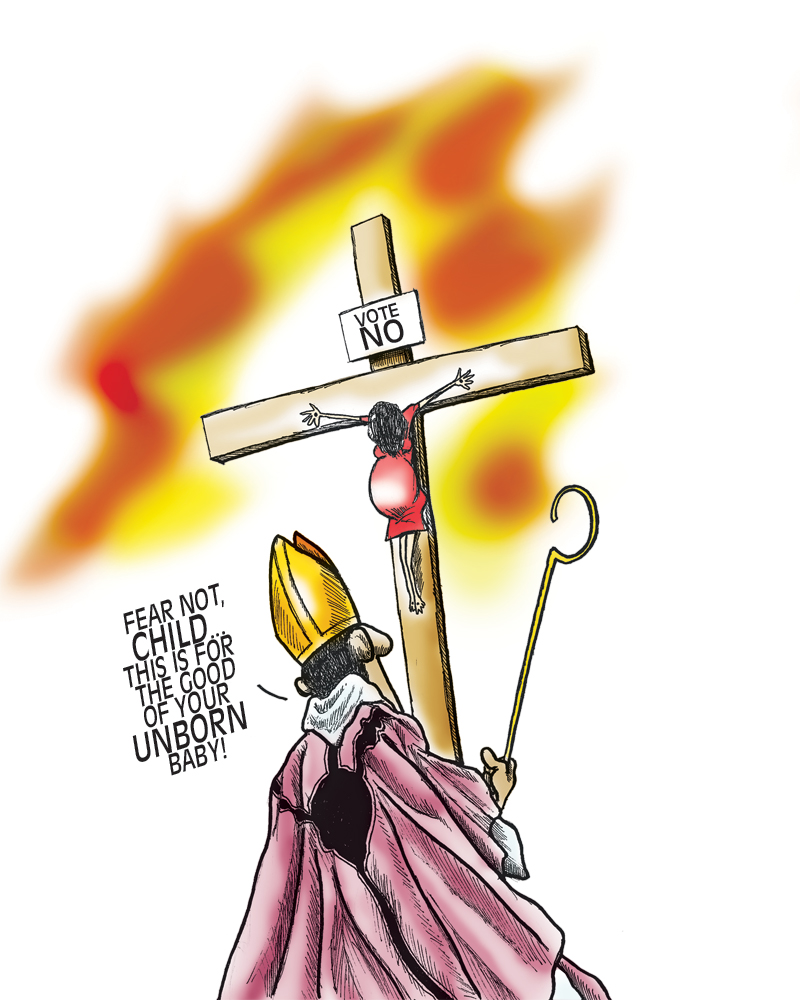
As the referendum on Kenya’s new constitution draws near, the debate over abortion is taking centre stage and threatening to derail the two-decade old project. Despite the fact that abortion has never been legal in Kenya, and the new draft expressly provides for matters to remain that way, Christian church leaders have vowed to mobilise their followers to reject the document.
The church objects to the section of Article 26 that empowers doctors to end a pregnancy if it endangers the woman’s life or she needs emergency treatment. Christian leaders are also opposed to the retention of Kadhis' courts in the proposed Constitution under Article 169 and 170, which limit their authority to disputes over personal status, marriage, divorce or inheritance, where all the parties are Muslims and agree to take the case to a Kadhi.
The controversy over the termination of pregnancy has pitted the church against pro-choice activists and is largely fought on the battlefields of values and morality. The debate has degenerated into shouting matches over the viability and humanity of foetuses and when exactly life begins. Lost in all this is the fact that, from a public policy perspective, these considerations are largely academic.
Banning abortion, as has been the experience worldwide, does not stop it. A survey of 197 countries carried out by the Guttmacher Institute — a pro-choice reproductive think tank — found that abortion occurs at roughly equal rates in regions where it is legal and regions where it is highly restricted.
Despite the current prohibition on abortion in Kenya’s laws, it is estimated that fully a fifth of total pregnancies in the country are terminated. Couching the ban in new phraseology is unlikely to alter this fact. This is not to say that the law has no effect. For nearly 300,000 women who seek abortions each year, it has proven to be a millstone around their necks.
The report, In Harm’s Way: The Impact Of Kenya’s Restrictive Abortion Law, compiled by the Centre for Reproductive Rights between June 2009 and February 2010, reveals that over 2,600 women die annually in Kenya and 21,000 are hospitalised each year in public hospitals due to complications arising from incomplete and unsafe abortions. The World Health Organisation thinks these numbers are gross underestimations due to underreporting. Worldwide, there are 19 million unsafe abortions every year, and they kill 70,000 women, accounting for 13 percent of maternal deaths. The vast majority occur in countries where abortion is illegal.
Why do so many Kenyan women seek abortions? Women’s activists say that women and girls, thrust uninformed and unprepared into a world of sexual politics, and then abandoned and condemned when their naivety predictably bears fruit, have little choice other than to turn to backstreet quacks. Though fertility levels have been halved since the 1970s, they are still double the government’s target. According to a 2003 study, 25 per cent of Kenyan girls and women aged 15 to 19 are either pregnant or have children. The 2003 Kenya Demographic and Health Survey revealed that close to half of all births are either unwanted or mistimed (wanted later). In a 1998 Alan Guttmacher Institute survey entitled Into a New World, 74 per cent of unmarried women aged 15-19 and 47 per cent of the married women reported their current pregnancy unwanted. If one also considers the pregnancies already terminated, it is then likely that significant majority of all conceptions are undesired and unplanned for.
This is compounded by ignorance of, and lack of access to, contraceptive methods. In 2003 70 per cent of all adolescents in the country engaged in unprotected sex and 85 per cent of girls and women aged 15 to 19 and 72 per cent of women aged 20 to 24 did not use contraceptives. A 1998 survey of Kenyan secondary school students found that only a third of males and a quarter of females knew that contraceptive pills had to be taken by the woman and not by the man; and even fewer knew the pills had to be taken daily, not just before sex. A report in the Nation last year revealed that young women used emergency pill far more regularly than recommended and that when it came to choosing emergency contraception, they consulted their schoolmates, the Internet and their boyfriends.
The consequences of pregnancy can be grim. The Nairobi-based Centre for the Study of Adolescence estimates that up to 13,000 Kenyan girls drop out of school every year as a result of pregnancy. These young girls are often treated as outcasts by their families. Many migrate to cities where they face unemployment, health risks and malnutrition. This, combined with the fact that the responsibility to care for a child born out of wedlock is placed squarely on the mother, condemns many to lives of hardship and grinding poverty.
The case of Ruth Njeri, a 20-year old domestic worker, is typical. She had to leave school after getting pregnant and then moved to Nairobi from her village in the Nakuru district in search of work as her father refused to support her or the baby. "I had completed my Form-IV (higher secondary) but after the child was born neither my family nor my school wanted me back. If I had wanted to study further at all, I had to go to a different school," she told the Inter Press Service news agency.
Many women already in informal or casual employment also fear for their jobs as employers are generally unwilling to afford them maternity leave. The social stigma too, can be overwhelming. “My parents would probably kick me out should they find out that I’m sexually active, so I don’t even want to imagine their reaction should I get pregnant today,” Sheila, a 22-year-old who is about to graduate from college, told the Nation last year. A Population Council study indicated that fear of pregnancy outweighs fear of contracting the HIV virus among E-pill (morning after pill) users — 79 per cent cited pregnancy as their biggest fear, while only 45 per cent thought they were at risk of contracting HIV through unprotected sex.
Further, despite the sharp decline in the number of women dying at childbirth over the past decade, Kenya still remains one of the most dangerous places in the world to give birth, ranking 13th out of 181 countries. In 2008, according to a study published in The Lancet, 6,200 Kenyan women died in childbirth, translating into roughly 413 maternal deaths per 100,000 live births, compared to a global average of 251 per 100,000 live births.
All this leads to predictable results. Studies in Kenya showed that 47 per cent of all young people below the age of 20 years who got pregnant while in school resorted to abortion. “Young unmarried women would rather seek an abortion than let their parents know that they’re pregnant,” says Wanjiku Gikang’a, a family therapist and university lecturer.
Confronted with these realities, the church prefers to bury its head in the Bible. Apparently caring little for practical concerns, it proposes supposedly eternal and unchanging dictates revealed to a dozen tribes wandering aimlessly in the desert more than 3,000 years ago, as appropriate policy solutions for a globalised world of over 6 billion. In fact, a recent study of religious attitudes in sub-Saharan Africa revealed that 57 per cent of Christians in Kenya favor making Bible the official law of the land. This is similar to Uganda’s Lord’s Resistance Army's deranged suggestion that a complex and modernising country be governed by the Ten Commandments.
The church continues to oppose sex education in schools and the free provision of contraception in order to “protect” adolescents’ morality. In 1997, the Catholic Church and anti-abortion groups forced the government to shelve a sessional paper on family life education that was to be discussed by parliament. If the paper had been adopted, sex education would have been introduced in schools and integrated with primary health care. The document would have been the basis for making students aware of the dangers of adolescent pregnancy, abortion, drug abuse, HIV/AIDS, and sexually transmitted diseases.
The Catholic Church’s view, that sex education would itself lead to sexual immorality at too early age, resulting in more teenage pregnancy, backstreet abortions and further spread of HIV/AIDS, is contradicted by the findings of Scholasticah Nganda, a member of the Sisters of Mercy, a Catholic women's order, and a lecturer at Kenyatta University's Department of Psychology. She states that primary school boys and girls are already engaged in sex and they are likely to continue to engage in premarital sex with or without sex education, citing a 2003 study of the policy of the Catholic Church that revealed that 81 per cent of Protestants, and 47 per cent of Catholics as well as 81.8per cent of health workers supported the introduction of sex education in schools.
In addition, while the churches paint a picture of a world where God wills every pregnancy to go to term, this is at odds with the evidence of nature. Spontaneous abortion (sometimes referred to as miscarriage) is a common experience for women. It is estimated that between 25 and 50 per cent of all conceptions spontaneously abort. Researchers do not have an exact figure due to the fact that when this occurs very early on, many women do not even know that they were ever pregnant. Fully a third of all pregnancies are spontaneously terminated by week 10 LMP (Last Menstrual Period), with studies suggesting reasons as morally irrelevant as age (one study found that pregnancies from men younger than 25 are 40 per cent less likely to end in miscarriage than those from men 25-29 years; women over 45 spontaneously abort 75 per cent of the time).
This is not to say that the unborn should be fair game. Each abortion, spontaneous or not, is a tragedy for it involves the death of a human being. The questions for the state — which unlike the church answers to the citizenry and not to God — should be these: What policy would lead to the least number of abortions? Is deterrence achieved by criminalising the act? Does legalising abortion lead to an increase in demand for the procedure?
As the evidence shows, legal restrictions, however severe, do not lead to fewer abortions. And since prohibition does not deter, legalising the procedure will not lead to an increase in the overall number of terminations — it just moves abortions from the backstreet and into proper medical facilities, saving women’s lives.
Indeed, when combined with sex education and the availability of contraception, a legal regime actually lowers demand for abortion. According to the 1998 Guttmacher Institute survey, nearly 46 million abortions were performed worldwide that year. Five years later, in 2003, despite the fact that 19 countries had liberalised their abortion laws over the period, and only three had tightened them, the total number of abortions worldwide had fallen to 41.5 million — amazing when one takes into account population growth. However, the number of unsafe abortions, which are overwhelmingly illegal, remained almost static. Therefore all the reductions happened in countries where the procedure was legal.
Researchers have also noted that while liberalisation was a key element in improving women's access to safer terminations and lowering demand, it was not the only factor. Even in countries where abortion is legal, lack of availability and cost still created a barrier. In India, for example, where terminations are legally allowed for a variety of reasons, some 6 million took place outside the formal health system. Other factors that were seen to be relevant to reducing the number of terminations included effective family planning services — which currently cost four times less than the public bill for sorting out conditions, from sepsis to organ failure, that result from botched abortions.
In much of Eastern Europe, where abortion was treated as a form of birth control, abortion rates dropped by 50 per cent as contraceptives became more widely available while globally, the number of married women of childbearing age with access to contraception had increased from 54 per cent in 1990 to 63 per cent in 2003.
Therefore, if public policy aims at reducing the number of abortions, securing the health of women and girls, and saving money in the process, then criminalising the procedure is not the solution. Legal terminations coupled with sex education, family planning services, and knowledge about as well as availability of contraception, are indisputably the way to go. In fact, addressing the 37th session of the UN's Commission on Population and Development in 2004, the then chief executive officer of the National Co-ordination Agency for Population and Development in the Ministry of Planning and National Development, Dr Richard Muga, affirmed that Kenya upheld the 1994 Cairo Plan of Action, which called for the integration of sexual education into the school curriculum and invited open debate on controversial issues, including abortion.
Even with all these measures in place, unwanted pregnancies, though greatly reduced in number, will continue to occur. To further reduce the instances of these turning into abortion cases, the government, since the early years of this century, has reversed the situation that previously saw pregnant schoolgirls barred from continuing their studies. The church could help out here by teaching its flock to be more accommodating and tolerant of those who have “fallen by the wayside” — those, incidentally, that Christ said were the ones he came to save.
The church objects to the section of Article 26 that empowers doctors to end a pregnancy if it endangers the woman’s life or she needs emergency treatment. Christian leaders are also opposed to the retention of Kadhis' courts in the proposed Constitution under Article 169 and 170, which limit their authority to disputes over personal status, marriage, divorce or inheritance, where all the parties are Muslims and agree to take the case to a Kadhi.
The controversy over the termination of pregnancy has pitted the church against pro-choice activists and is largely fought on the battlefields of values and morality. The debate has degenerated into shouting matches over the viability and humanity of foetuses and when exactly life begins. Lost in all this is the fact that, from a public policy perspective, these considerations are largely academic.
Banning abortion, as has been the experience worldwide, does not stop it. A survey of 197 countries carried out by the Guttmacher Institute — a pro-choice reproductive think tank — found that abortion occurs at roughly equal rates in regions where it is legal and regions where it is highly restricted.
Despite the current prohibition on abortion in Kenya’s laws, it is estimated that fully a fifth of total pregnancies in the country are terminated. Couching the ban in new phraseology is unlikely to alter this fact. This is not to say that the law has no effect. For nearly 300,000 women who seek abortions each year, it has proven to be a millstone around their necks.
The report, In Harm’s Way: The Impact Of Kenya’s Restrictive Abortion Law, compiled by the Centre for Reproductive Rights between June 2009 and February 2010, reveals that over 2,600 women die annually in Kenya and 21,000 are hospitalised each year in public hospitals due to complications arising from incomplete and unsafe abortions. The World Health Organisation thinks these numbers are gross underestimations due to underreporting. Worldwide, there are 19 million unsafe abortions every year, and they kill 70,000 women, accounting for 13 percent of maternal deaths. The vast majority occur in countries where abortion is illegal.
Why do so many Kenyan women seek abortions? Women’s activists say that women and girls, thrust uninformed and unprepared into a world of sexual politics, and then abandoned and condemned when their naivety predictably bears fruit, have little choice other than to turn to backstreet quacks. Though fertility levels have been halved since the 1970s, they are still double the government’s target. According to a 2003 study, 25 per cent of Kenyan girls and women aged 15 to 19 are either pregnant or have children. The 2003 Kenya Demographic and Health Survey revealed that close to half of all births are either unwanted or mistimed (wanted later). In a 1998 Alan Guttmacher Institute survey entitled Into a New World, 74 per cent of unmarried women aged 15-19 and 47 per cent of the married women reported their current pregnancy unwanted. If one also considers the pregnancies already terminated, it is then likely that significant majority of all conceptions are undesired and unplanned for.
This is compounded by ignorance of, and lack of access to, contraceptive methods. In 2003 70 per cent of all adolescents in the country engaged in unprotected sex and 85 per cent of girls and women aged 15 to 19 and 72 per cent of women aged 20 to 24 did not use contraceptives. A 1998 survey of Kenyan secondary school students found that only a third of males and a quarter of females knew that contraceptive pills had to be taken by the woman and not by the man; and even fewer knew the pills had to be taken daily, not just before sex. A report in the Nation last year revealed that young women used emergency pill far more regularly than recommended and that when it came to choosing emergency contraception, they consulted their schoolmates, the Internet and their boyfriends.
The consequences of pregnancy can be grim. The Nairobi-based Centre for the Study of Adolescence estimates that up to 13,000 Kenyan girls drop out of school every year as a result of pregnancy. These young girls are often treated as outcasts by their families. Many migrate to cities where they face unemployment, health risks and malnutrition. This, combined with the fact that the responsibility to care for a child born out of wedlock is placed squarely on the mother, condemns many to lives of hardship and grinding poverty.
The case of Ruth Njeri, a 20-year old domestic worker, is typical. She had to leave school after getting pregnant and then moved to Nairobi from her village in the Nakuru district in search of work as her father refused to support her or the baby. "I had completed my Form-IV (higher secondary) but after the child was born neither my family nor my school wanted me back. If I had wanted to study further at all, I had to go to a different school," she told the Inter Press Service news agency.
Many women already in informal or casual employment also fear for their jobs as employers are generally unwilling to afford them maternity leave. The social stigma too, can be overwhelming. “My parents would probably kick me out should they find out that I’m sexually active, so I don’t even want to imagine their reaction should I get pregnant today,” Sheila, a 22-year-old who is about to graduate from college, told the Nation last year. A Population Council study indicated that fear of pregnancy outweighs fear of contracting the HIV virus among E-pill (morning after pill) users — 79 per cent cited pregnancy as their biggest fear, while only 45 per cent thought they were at risk of contracting HIV through unprotected sex.
Further, despite the sharp decline in the number of women dying at childbirth over the past decade, Kenya still remains one of the most dangerous places in the world to give birth, ranking 13th out of 181 countries. In 2008, according to a study published in The Lancet, 6,200 Kenyan women died in childbirth, translating into roughly 413 maternal deaths per 100,000 live births, compared to a global average of 251 per 100,000 live births.
All this leads to predictable results. Studies in Kenya showed that 47 per cent of all young people below the age of 20 years who got pregnant while in school resorted to abortion. “Young unmarried women would rather seek an abortion than let their parents know that they’re pregnant,” says Wanjiku Gikang’a, a family therapist and university lecturer.
Confronted with these realities, the church prefers to bury its head in the Bible. Apparently caring little for practical concerns, it proposes supposedly eternal and unchanging dictates revealed to a dozen tribes wandering aimlessly in the desert more than 3,000 years ago, as appropriate policy solutions for a globalised world of over 6 billion. In fact, a recent study of religious attitudes in sub-Saharan Africa revealed that 57 per cent of Christians in Kenya favor making Bible the official law of the land. This is similar to Uganda’s Lord’s Resistance Army's deranged suggestion that a complex and modernising country be governed by the Ten Commandments.
The church continues to oppose sex education in schools and the free provision of contraception in order to “protect” adolescents’ morality. In 1997, the Catholic Church and anti-abortion groups forced the government to shelve a sessional paper on family life education that was to be discussed by parliament. If the paper had been adopted, sex education would have been introduced in schools and integrated with primary health care. The document would have been the basis for making students aware of the dangers of adolescent pregnancy, abortion, drug abuse, HIV/AIDS, and sexually transmitted diseases.
The Catholic Church’s view, that sex education would itself lead to sexual immorality at too early age, resulting in more teenage pregnancy, backstreet abortions and further spread of HIV/AIDS, is contradicted by the findings of Scholasticah Nganda, a member of the Sisters of Mercy, a Catholic women's order, and a lecturer at Kenyatta University's Department of Psychology. She states that primary school boys and girls are already engaged in sex and they are likely to continue to engage in premarital sex with or without sex education, citing a 2003 study of the policy of the Catholic Church that revealed that 81 per cent of Protestants, and 47 per cent of Catholics as well as 81.8per cent of health workers supported the introduction of sex education in schools.
In addition, while the churches paint a picture of a world where God wills every pregnancy to go to term, this is at odds with the evidence of nature. Spontaneous abortion (sometimes referred to as miscarriage) is a common experience for women. It is estimated that between 25 and 50 per cent of all conceptions spontaneously abort. Researchers do not have an exact figure due to the fact that when this occurs very early on, many women do not even know that they were ever pregnant. Fully a third of all pregnancies are spontaneously terminated by week 10 LMP (Last Menstrual Period), with studies suggesting reasons as morally irrelevant as age (one study found that pregnancies from men younger than 25 are 40 per cent less likely to end in miscarriage than those from men 25-29 years; women over 45 spontaneously abort 75 per cent of the time).
This is not to say that the unborn should be fair game. Each abortion, spontaneous or not, is a tragedy for it involves the death of a human being. The questions for the state — which unlike the church answers to the citizenry and not to God — should be these: What policy would lead to the least number of abortions? Is deterrence achieved by criminalising the act? Does legalising abortion lead to an increase in demand for the procedure?
As the evidence shows, legal restrictions, however severe, do not lead to fewer abortions. And since prohibition does not deter, legalising the procedure will not lead to an increase in the overall number of terminations — it just moves abortions from the backstreet and into proper medical facilities, saving women’s lives.
Indeed, when combined with sex education and the availability of contraception, a legal regime actually lowers demand for abortion. According to the 1998 Guttmacher Institute survey, nearly 46 million abortions were performed worldwide that year. Five years later, in 2003, despite the fact that 19 countries had liberalised their abortion laws over the period, and only three had tightened them, the total number of abortions worldwide had fallen to 41.5 million — amazing when one takes into account population growth. However, the number of unsafe abortions, which are overwhelmingly illegal, remained almost static. Therefore all the reductions happened in countries where the procedure was legal.
Researchers have also noted that while liberalisation was a key element in improving women's access to safer terminations and lowering demand, it was not the only factor. Even in countries where abortion is legal, lack of availability and cost still created a barrier. In India, for example, where terminations are legally allowed for a variety of reasons, some 6 million took place outside the formal health system. Other factors that were seen to be relevant to reducing the number of terminations included effective family planning services — which currently cost four times less than the public bill for sorting out conditions, from sepsis to organ failure, that result from botched abortions.
In much of Eastern Europe, where abortion was treated as a form of birth control, abortion rates dropped by 50 per cent as contraceptives became more widely available while globally, the number of married women of childbearing age with access to contraception had increased from 54 per cent in 1990 to 63 per cent in 2003.
Therefore, if public policy aims at reducing the number of abortions, securing the health of women and girls, and saving money in the process, then criminalising the procedure is not the solution. Legal terminations coupled with sex education, family planning services, and knowledge about as well as availability of contraception, are indisputably the way to go. In fact, addressing the 37th session of the UN's Commission on Population and Development in 2004, the then chief executive officer of the National Co-ordination Agency for Population and Development in the Ministry of Planning and National Development, Dr Richard Muga, affirmed that Kenya upheld the 1994 Cairo Plan of Action, which called for the integration of sexual education into the school curriculum and invited open debate on controversial issues, including abortion.
Even with all these measures in place, unwanted pregnancies, though greatly reduced in number, will continue to occur. To further reduce the instances of these turning into abortion cases, the government, since the early years of this century, has reversed the situation that previously saw pregnant schoolgirls barred from continuing their studies. The church could help out here by teaching its flock to be more accommodating and tolerant of those who have “fallen by the wayside” — those, incidentally, that Christ said were the ones he came to save.
Subscribe to:
Posts (Atom)