Followers

Showing posts with label abortion. Show all posts

Sunday, May 12, 2013

Are We Trying To Fake It Till We Make It?

There is an interesting scene in one of those dreary, black and white independence era TV documentaries that the media trots out every national holiday. A colonial settler expresses his shock and outrage at the brutality of the Mau Mau uprising. He seems genuinely outraged that a man to whom you have been kind enough to offer employment, whose kids play with yours and who you have even allowed to live on and farm a small corner of your land, could steal into your house in the dead of night and massacre your entire family.

Of course, what makes the statement so unbelievably cretinous is the idea that the Africans should have been grateful for getting back a tiny fraction of what had been stolen from them. It seems that the colonials had come to believe their own hype, that the country's bounty was theirs as of right. Today, I can't help feeling that we , inheritors of the artificial country and systems they created, have been similarly lying to ourselves, and have become victims of our own hubris.

The problem with fake societies is their people do not feel anything more than a superficial duty to them.

Consider the recent elections. We invested a great deal of money in technology meant to safeguard its credibility and disregarded all concerns about its efficacy. When it all failed, we were unwilling to even consider that the results might be fraudulent. Despite all our earnest protestations, we were not really interested in democracy or the will of the people or justice. We were, on the contrary, quite content to fake a free and fair poll. Like the settler, we were careful not to give it too much thought lest we discover what lay under our seemingly honest exterior.

Similarly we celebrate our new and improved constitution even when it seems to do nothing to regulate the behaviour of our famously avaricious politicians. We speak reverently of a reformed judiciary though it still seems incapable of delivering justice. We have a penchant to compare the young(ish) duo in Statehouse with US President Barrack Obama,  all the while pretending that it is normal to have an ICC-indicted president who has to be whisked through the cargo terminals of international airports, hidden from the press and whose hosts are camera-shy when he's around.

Today the carpet of economic growth covers many ills. On the back of GDP figures and the number of kilometres of tarmac and fibre optic cable, we are taught to believe that things are improving, the country is moving forward, that we should just sit back and enjoy the ride. As a result, buoyed by narratives of a rising Africa and blinded by the gleaming towers of our cities, we forget that we live in one of the most unequal countries on earth, where wealth is concentrated in the top ten percent. On a per capita basis, the biggest economy in East Africa, as we like to refer to ourselves, ranks only a mediocre 24th out of 48 sub-Saharan economies. One survey of the income distribution of workers in the formal sector found that the top 10 percent lived off monthly wages that were more than 6 times those of the bottom 90 percent. In fact, another study found that the top 10 percent of households control nearly half of total income while the bottom 10 percent take home nearly nothing.

We have little inkling of the country that lies beyond those numbers which is still very much a Hobbesian one. Where men live without security and in constant fear of a violent death; where life is "solitary, poor, nasty, brutish, and short." It is a place where people are set alight while crowds cheer and where young girls can be pulled kicking and screaming from crowded commuter buses to be gang-raped without anybody intervening.

We prefer the compartmentalized view, the trees to the wood. Thus we periodically rotate the thieves in government without tackling the systemic attitudes that incentivize bad behaviour. Like turning a blind eye to the rip-off that is the presidential retirement package while at the same time berating Mps for trying to get in on the enrichment act. We reach for legal bans as a quick fix to social problems even when we know that the laws are rarely enforced and even when they are, provide avenues for graft, can be ineffective and can even create worse problems. We thus celebrate traffic rules that fill the government coffers without doing anything about the anarchy on our roads and abortion bans whose only effect is to kill and maim our women and girls.

One would think it would be the job of the media to disabuse us of such inaccurate notions. But the fact is, the Kenyan media long ago shirked its duty to expose truth and to challenge our assumptions. In fact, it is itself a mirror of the society it serves. Famed across the globe as one of the most vibrant on the continent, it has produced award winning journalists by the dozen, many of whom have been snapped up by international networks. Yet back home,  they are not given to critical scrutiny and revel in sensational tales of superstition and sex. For our comfort and pleasure, they provide us with a smattering of sanitized news bulletins conservatively sprinkled atop a diet of entertainment and advertising.

Though loudly proclaiming their independence and objectivity, they nonetheless seem almost as ignorant as those they are supposed to inform. As I was writing this, the news anchor on TV was saying something about the Mandera clashes. She declared, with little apparent embarrassment, that the fighting had been going on "unreported" for 3 months. It was unclear whose job she thought it was to do the reporting.

It seems that we are a nation that is determined to fake its way through the world. That we believe we can continue to pretend to be virtuous or successful and all will be well. However, at the end of that road lies an inevitable and painful collision with reality. Like the colonial settlers, we will eventually discover that we cannot paper over the truth indefinitely.

Monday, April 19, 2010

It's Public Policy, Stupid!


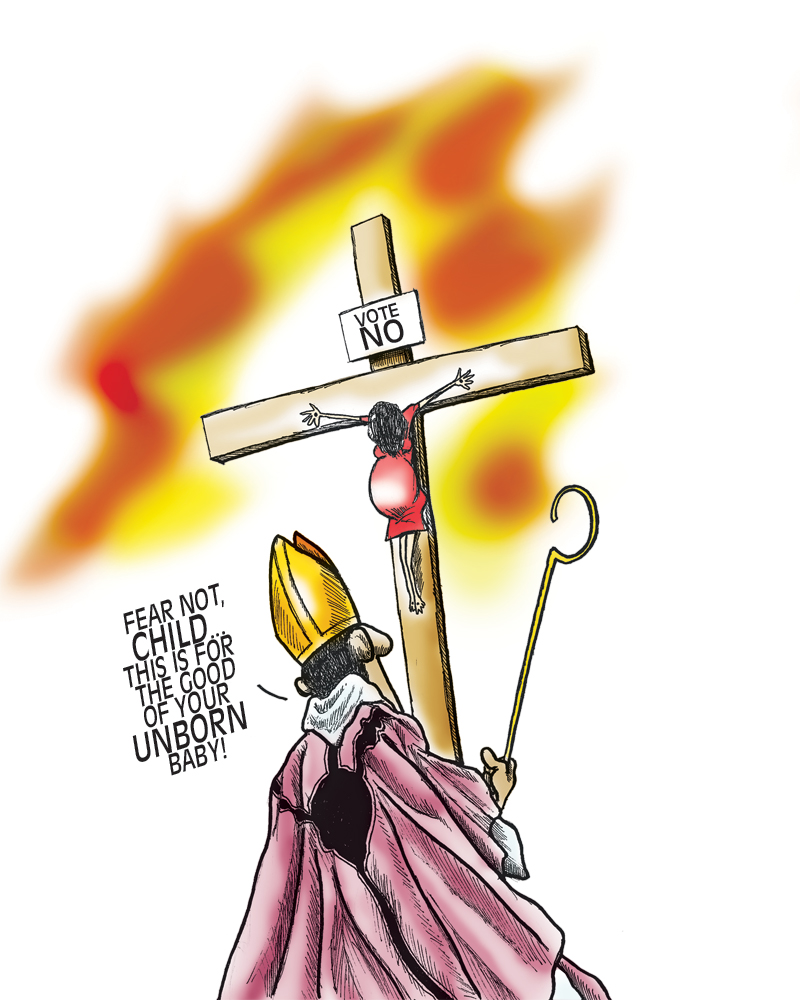
As the referendum on Kenya’s new constitution draws near, the debate over abortion is taking centre stage and threatening to derail the two-decade old project. Despite the fact that abortion has never been legal in Kenya, and the new draft expressly provides for matters to remain that way, Christian church leaders have vowed to mobilise their followers to reject the document.

The church objects to the section of Article 26 that empowers doctors to end a pregnancy if it endangers the woman’s life or she needs emergency treatment. Christian leaders are also opposed to the retention of Kadhis' courts in the proposed Constitution under Article 169 and 170, which limit their authority to disputes over personal status, marriage, divorce or inheritance, where all the parties are Muslims and agree to take the case to a Kadhi.

The controversy over the termination of pregnancy has pitted the church against pro-choice activists and is largely fought on the battlefields of values and morality. The debate has degenerated into shouting matches over the viability and humanity of foetuses and when exactly life begins. Lost in all this is the fact that, from a public policy perspective, these considerations are largely academic.

Banning abortion, as has been the experience worldwide, does not stop it. A survey of 197 countries carried out by the Guttmacher Institute — a pro-choice reproductive think tank — found that abortion occurs at roughly equal rates in regions where it is legal and regions where it is highly restricted.

Despite the current prohibition on abortion in Kenya’s laws, it is estimated that fully a fifth of total pregnancies in the country are terminated. Couching the ban in new phraseology is unlikely to alter this fact. This is not to say that the law has no effect. For nearly 300,000 women who seek abortions each year, it has proven to be a millstone around their necks.

The report, In Harm’s Way: The Impact Of Kenya’s Restrictive Abortion Law, compiled by the Centre for Reproductive Rights between June 2009 and February 2010, reveals that over 2,600 women die annually in Kenya and 21,000 are hospitalised each year in public hospitals due to complications arising from incomplete and unsafe abortions. The World Health Organisation thinks these numbers are gross underestimations due to underreporting. Worldwide, there are 19 million unsafe abortions every year, and they kill 70,000 women, accounting for 13 percent of maternal deaths. The vast majority occur in countries where abortion is illegal.

Why do so many Kenyan women seek abortions? Women’s activists say that women and girls, thrust uninformed and unprepared into a world of sexual politics, and then abandoned and condemned when their naivety predictably bears fruit, have little choice other than to turn to backstreet quacks. Though fertility levels have been halved since the 1970s, they are still double the government’s target. According to a 2003 study, 25 per cent of Kenyan girls and women aged 15 to 19 are either pregnant or have children. The 2003 Kenya Demographic and Health Survey revealed that close to half of all births are either unwanted or mistimed (wanted later). In a 1998 Alan Guttmacher Institute survey entitled Into a New World, 74 per cent of unmarried women aged 15-19 and 47 per cent of the married women reported their current pregnancy unwanted. If one also considers the pregnancies already terminated, it is then likely that significant majority of all conceptions are undesired and unplanned for.

This is compounded by ignorance of, and lack of access to, contraceptive methods. In 2003 70 per cent of all adolescents in the country engaged in unprotected sex and 85 per cent of girls and women aged 15 to 19 and 72 per cent of women aged 20 to 24 did not use contraceptives. A 1998 survey of Kenyan secondary school students found that only a third of males and a quarter of females knew that contraceptive pills had to be taken by the woman and not by the man; and even fewer knew the pills had to be taken daily, not just before sex. A report in the Nation last year revealed that young women used emergency pill far more regularly than recommended and that when it came to choosing emergency contraception, they consulted their schoolmates, the Internet and their boyfriends.

The consequences of pregnancy can be grim. The Nairobi-based Centre for the Study of Adolescence estimates that up to 13,000 Kenyan girls drop out of school every year as a result of pregnancy. These young girls are often treated as outcasts by their families. Many migrate to cities where they face unemployment, health risks and malnutrition. This, combined with the fact that the responsibility to care for a child born out of wedlock is placed squarely on the mother, condemns many to lives of hardship and grinding poverty.

The case of Ruth Njeri, a 20-year old domestic worker, is typical. She had to leave school after getting pregnant and then moved to Nairobi from her village in the Nakuru district in search of work as her father refused to support her or the baby. "I had completed my Form-IV (higher secondary) but after the child was born neither my family nor my school wanted me back. If I had wanted to study further at all, I had to go to a different school," she told the Inter Press Service news agency.

Many women already in informal or casual employment also fear for their jobs as employers are generally unwilling to afford them maternity leave. The social stigma too, can be overwhelming. “My parents would probably kick me out should they find out that I’m sexually active, so I don’t even want to imagine their reaction should I get pregnant today,” Sheila, a 22-year-old who is about to graduate from college, told the Nation last year. A Population Council study indicated that fear of pregnancy outweighs fear of contracting the HIV virus among E-pill (morning after pill) users — 79 per cent cited pregnancy as their biggest fear, while only 45 per cent thought they were at risk of contracting HIV through unprotected sex.

Further, despite the sharp decline in the number of women dying at childbirth over the past decade, Kenya still remains one of the most dangerous places in the world to give birth, ranking 13th out of 181 countries. In 2008, according to a study published in The Lancet, 6,200 Kenyan women died in childbirth, translating into roughly 413 maternal deaths per 100,000 live births, compared to a global average of 251 per 100,000 live births.

All this leads to predictable results. Studies in Kenya showed that 47 per cent of all young people below the age of 20 years who got pregnant while in school resorted to abortion. “Young unmarried women would rather seek an abortion than let their parents know that they’re pregnant,” says Wanjiku Gikang’a, a family therapist and university lecturer.

Confronted with these realities, the church prefers to bury its head in the Bible. Apparently caring little for practical concerns, it proposes supposedly eternal and unchanging dictates revealed to a dozen tribes wandering aimlessly in the desert more than 3,000 years ago, as appropriate policy solutions for a globalised world of over 6 billion. In fact, a recent study of religious attitudes in sub-Saharan Africa revealed that 57 per cent of Christians in Kenya favor making Bible the official law of the land. This is similar to Uganda’s Lord’s Resistance Army's deranged suggestion that a complex and modernising country be governed by the Ten Commandments.

The church continues to oppose sex education in schools and the free provision of contraception in order to “protect” adolescents’ morality. In 1997, the Catholic Church and anti-abortion groups forced the government to shelve a sessional paper on family life education that was to be discussed by parliament. If the paper had been adopted, sex education would have been introduced in schools and integrated with primary health care. The document would have been the basis for making students aware of the dangers of adolescent pregnancy, abortion, drug abuse, HIV/AIDS, and sexually transmitted diseases.

The Catholic Church’s view, that sex education would itself lead to sexual immorality at too early age, resulting in more teenage pregnancy, backstreet abortions and further spread of HIV/AIDS, is contradicted by the findings of Scholasticah Nganda, a member of the Sisters of Mercy, a Catholic women's order, and a lecturer at Kenyatta University's Department of Psychology. She states that primary school boys and girls are already engaged in sex and they are likely to continue to engage in premarital sex with or without sex education, citing a 2003 study of the policy of the Catholic Church that revealed that 81 per cent of Protestants, and 47 per cent of Catholics as well as 81.8per cent of health workers supported the introduction of sex education in schools.

In addition, while the churches paint a picture of a world where God wills every pregnancy to go to term, this is at odds with the evidence of nature. Spontaneous abortion (sometimes referred to as miscarriage) is a common experience for women. It is estimated that between 25 and 50 per cent of all conceptions spontaneously abort. Researchers do not have an exact figure due to the fact that when this occurs very early on, many women do not even know that they were ever pregnant. Fully a third of all pregnancies are spontaneously terminated by week 10 LMP (Last Menstrual Period), with studies suggesting reasons as morally irrelevant as age (one study found that pregnancies from men younger than 25 are 40 per cent less likely to end in miscarriage than those from men 25-29 years; women over 45 spontaneously abort 75 per cent of the time).

This is not to say that the unborn should be fair game. Each abortion, spontaneous or not, is a tragedy for it involves the death of a human being. The questions for the state — which unlike the church answers to the citizenry and not to God — should be these: What policy would lead to the least number of abortions? Is deterrence achieved by criminalising the act? Does legalising abortion lead to an increase in demand for the procedure?

As the evidence shows, legal restrictions, however severe, do not lead to fewer abortions. And since prohibition does not deter, legalising the procedure will not lead to an increase in the overall number of terminations — it just moves abortions from the backstreet and into proper medical facilities, saving women’s lives.

Indeed, when combined with sex education and the availability of contraception, a legal regime actually lowers demand for abortion. According to the 1998 Guttmacher Institute survey, nearly 46 million abortions were performed worldwide that year. Five years later, in 2003, despite the fact that 19 countries had liberalised their abortion laws over the period, and only three had tightened them, the total number of abortions worldwide had fallen to 41.5 million — amazing when one takes into account population growth. However, the number of unsafe abortions, which are overwhelmingly illegal, remained almost static. Therefore all the reductions happened in countries where the procedure was legal.

Researchers have also noted that while liberalisation was a key element in improving women's access to safer terminations and lowering demand, it was not the only factor. Even in countries where abortion is legal, lack of availability and cost still created a barrier. In India, for example, where terminations are legally allowed for a variety of reasons, some 6 million took place outside the formal health system. Other factors that were seen to be relevant to reducing the number of terminations included effective family planning services — which currently cost four times less than the public bill for sorting out conditions, from sepsis to organ failure, that result from botched abortions.

In much of Eastern Europe, where abortion was treated as a form of birth control, abortion rates dropped by 50 per cent as contraceptives became more widely available while globally, the number of married women of childbearing age with access to contraception had increased from 54 per cent in 1990 to 63 per cent in 2003.

Therefore, if public policy aims at reducing the number of abortions, securing the health of women and girls, and saving money in the process, then criminalising the procedure is not the solution. Legal terminations coupled with sex education, family planning services, and knowledge about as well as availability of contraception, are indisputably the way to go. In fact, addressing the 37th session of the UN's Commission on Population and Development in 2004, the then chief executive officer of the National Co-ordination Agency for Population and Development in the Ministry of Planning and National Development, Dr Richard Muga, affirmed that Kenya upheld the 1994 Cairo Plan of Action, which called for the integration of sexual education into the school curriculum and invited open debate on controversial issues, including abortion.

Even with all these measures in place, unwanted pregnancies, though greatly reduced in number, will continue to occur. To further reduce the instances of these turning into abortion cases, the government, since the early years of this century, has reversed the situation that previously saw pregnant schoolgirls barred from continuing their studies. The church could help out here by teaching its flock to be more accommodating and tolerant of those who have “fallen by the wayside” — those, incidentally, that Christ said were the ones he came to save.

Thursday, April 15, 2010

Snake Mail

In addition to this email that M has dispatched with deserved contempt, I also received the following FAQs from our churches. My reactions to both underneath.


Kenya Christian Leaders Forum
Frequently Asked Questions on Contentious Issues in the Constitution Review Process


1. Why is a National Constitution important?

The Constitution of a nation is the most important governance document. It is the mother and father of all laws. Any law that is in conflict with the Constitution is null and void. It defines the people, their values and the nation and its destiny. Kenya 's current constitution was written in London with the help of the British colonialist. It is under review to correct past anomalies and ensure justice, fairness and equity for everyone.

2. Why are Christians against Kadhis Courts in the Draft Constitution?

Christians are against the inclusion of Kadhis Courts because it is an outright injustice to other religions. Kenya is a multi-religious society! Christians' objections to the inclusion of Kadhi Courts were ignored by the government, the Constitution of Kenya Review Commission, the BOMAS gathering, the Committee of Experts and most recently the Parliamentary Select Committee. Christians are left with no choice but to vote against the new Constitution unless the Courts are removed.

3. Are Christians against Muslims?

No. Christians are not against Muslims. They are against injustice and unfairness in the draft constitution perpetrated by the Government and the review organs.

4. Why didn't Christians request for Christian Courts?

Christians seek for a just society for all Kenyans, not only the rights of Christians. They advocated for an effective executive with an accountable President, an effective Parliament, an efficient judiciary, and respect for the rights and responsibilities that promote an equitable, just and moral values based society. The Constitution must set up a Judiciary that is good for all Kenyans.

5. How come Kadhis Court was not identified as a contentious issue by the Committee of experts?

Christians submitted thousands of memoranda to the Committee of Experts rejecting the inclusion of Kadhis courts in the constitution. The Committee of Experts deliberately refused to identify Kadhis Courts as a contentious issue. Instead, the Committee of Experts that was supposed to be impartial, was partisan and openly campaigned for inclusion of Kadhis Courts in the constitution. We now think it was deliberate because Muslims have dominated the Committee of Experts and the Parliamentary Select Committee.

6. Are there Christian MPs in Parliament who can speak for Christians the way Muslim MPs do?

There are Christian members of Parliament, but they have been silent. They have not stood for what is right and just. Church leaders are calling on Christian MPs to stand up and be counted. In future, we urge you as a citizen to vote for those people who will not sit by and watch as our country is sold out. Meanwhile, Christians must organize themselves under the Lords guidance and speak the truth even if MPs fail us.

7. So what do Christians want?

It is not what Christians want but rather what Kenyans want. Kenyans want a constitution that defines how society is organized on the basis of justice, truth, fairness, effective checks and balances, and an effective bill of rights for all Kenyans. With regard to religion, it should be one that provides for freedom of worship to people of all faiths under the Bill of Rights. The Constitution of Kenya must remain neutral with regard to religion, in order to offer equal protection to the people of all religions.

8. Why are Christians opposed to Kadhis courts yet they have not harmed any body?

The fact that the Kadhi Courts did not harm non-Muslims does not mean it was right for them to be included in the Constitution. It was wrong and discriminatory against the people of other faiths from the beginning. Kenyans' patience since independence must not be taken for granted. It is time to correct all wrong things. Muslims should by now be an integral part of the Kenyan community not requiring special treatment or protection! The constitution must not divide the people along religious or other lines. Kenyans want one nation, one land, one law that caters for all irrespective of religious affiliation. This is the practice in stable democracies around the world. We should not let a new constitution to perpetuate past injustices. Christ said: "And no one pours new wine into old wineskins. If he does, the wine will burst the skins, and both the wine and the wineskins will be ruined. No, he pours new wine into new wineskins” (Mark 2:22). Inclusion of Kadhis Courts in the new constitution is like pouring new wine into old wineskins. It will burst the skins.

9. Who qualifies to be a Kadhi?

A Kadhi is a Muslim judge or magistrate. While many claim that the Kadhi is a purely judicial officer who serves in a Kadhis Court , they in Kenya they perform religious functions. The Chief Kadhi declares the beginning of Ramadhan a major Muslim religious festival. As an officer of government, it is discriminatory that, to be a Kadhi, one must profess the MUSLIM RELIGION. This means even if a Christian possesses knowledge of the MUSLIM LAW applicable to any SECTS OF MUSLIMS, he cannot serve as a Kadhi, meanwhile Muslims can preside over cases of non Muslims!

10. What law does Kadhis Court enforce?

Kadhis Courts enforce Islamic law commonly referred to as Sharia. Sharia is the Arabic word where our Kiswahili word Sheria is borrowed from. Sharia is the law system based on the the Koran, the Sunna, older Arabic law systems, parallel traditions, and the work of Muslim scholars over the two first centuries of Islam.

11. What are the implications of the inclusion of Kadhis Courts in the Constitution?

The inclusion of Islamic Sharia courts in the constitution divides Kenyans along religious lines. It would reinforce two classes of Kenyans, Muslims and the rest. Kenyans are seeking a constitution that unites.

12. Is the draft constitution Christian?

No. The draft Constitution is a collection of all just and fair laws from any source where they may be found. It draws from Judeo-Christian principles of equality, fairness, justice and equity does not make it Christian! These are values recognized by people from all religions, ethnic communities or professional backgrounds. We as Kenyans do not want a Christian or Muslim or Hindu constitution. We want a Kenyan constitution made by all Kenyans for all Kenyans. Unfortunately, as it is now, the constitution appears to be Islamic! It mentions the word Muslim 6 times, and Kadhis 5 times. It does not mention the word Christian at all!

13. What have Christians proposed?

That the Constitution recognizes every Kenyans freedom of worship. That every Kenyan worships and submits to the religion they choose at their own cost and not government's cost. We appeal that all religious beliefs and practices be left to the Churches, Mosques and Temples where they belong.

14. Did Jomo Kenyatta agree with the Sultan to entrench Kadhis Court in the constitution?

No. Kenyatta undertook to the Sultan of Zanzibar to only preserve the jurisdiction of Kadhis courts. The Kadhi was to operate in the ten mile Coastal strip. While Section 66 of the current constitution provides that the Chief Kadhi and the Kadhis “shall each be empowered to hold a Kadhis court having jurisdiction within the former Protectorate or within such part of the former Protectorate as may be so prescribed”, the government violated the constitution and established Kadhis Courts in areas which are outside the ten mile coastal strip like. Christians filed a case in court to challenge this wanton violation of the constitution of Kenya .

15. If Christians succeed in rejecting the constitution during the referendum, will we not still have Kadhis Courts under the current Constitution any way?

Christians are actively involved in this matter and will not stop at a No vote at the referendum. Christians filed a case in the High Court in 2004 to declare Kadhis Court unconstitutional. The hearing ended in February 2009. It is regrettable that time has lapsed and the High Court is yet to deliver the judgment. Christians will next sponsor a motion in Parliament to amend the current constitution to delete section 66 which provides for Kadhis Court .

16. Should Kenyans reject the draft constitution just because it has Kadhis Courts?

Yes. If you had a soda with a small amount of poison, would you drink it? Let us not be deceived by people who either do not have the interest of Kenya at heart or are unable to see divisiveness of this issue. If they are serious and want us to accept the new constitution, let them delete all references to the Kadhis Court in the constitution.

17. Is it true that the Bill of Rights shall not apply to Muslims?

Yes. Muslims are the only Kenyans who are allowed to violate the Bill of Rights. Kenyans should not allow this to happen. Let every Kenyan be equal before the law of the land and particularly the Bill of Rights.

18. If Christians succeed in rejecting the Kadhis Court, will the Muslims unleash violence?

No. Christians and Kenyans in general should not allow themselves to be manipulated and intimidated by the threat of violence. Kenya is a democracy, Muslims must argue with ideas and the ballot box, not violence. In any case, it is hoped that Muslims in Kenya are peace loving and will respect the decision of Kenyans. The threat by some Muslim leaders to secede from Kenya is a matter that the security forces are able to handle.

19. What about abortion?

Abortion is the willful termination of a woman's pregnancy on the basis that it is unwanted. A woman may herself be under pressure because she desires to hide the fact or may be under pressure from other person(s) for the same reasons

20. When does life begin?

Life begins at Conception. All doctors who claim that life begins at birth are professionally untrustworthy, because the fetus in the mother's womb are usually alive. Whenever a fetus dies, it is always an emergency to operate and to remove it.

21. What do Pro-abortionists want?

Their interest is to make money from vulnerable women. In the course of the abortion process the life of the woman is endangered, their conscience and faith are trashed and they become guilty of murder.

22. What does God say about the life of the unborn?

The unborn babies are complete human beings created in the image of God. Any one who aborts them is a murderer. God called Jeremiah in the mother's womb (Jer. 1:4-5). When Mary after she became pregnant met Elizabeth , John leaped in her womb to rejoice at Jesus. (Lk 1:41-44). God commanded that His people in the sixth commandment, 'Thou shalt not kill.' (Ex 20:13) Abortion is murder, the killing of the unborn innocents.

23. Does anti-abortion law hinder the practice of medicine?

No. The constitution allows a doctor, upon medical examination of a pregnant woman, to terminate a pregnancy if the life of the mother faces a medical condition that leads to the death of both mother and baby.

24. What about Marriage?

The Constitution must state that Marriage in Kenya is between two adults of the opposite sex. It must not allow any type of marriage which God calls an abomination. For us as Kenyans, let us pray that God blesses our men and women to form godly and healthy marriages.

25. What can I do as a Kenyan?

As a citizen of this nation you must make your voice heard on these matters! You also need to do the following:
  • You must read and understand the draft Constitution personally
  • Petition your Members of Parliament to delete all the sections referring to Kadhis Courts, or that introduce any unacceptable laws in the Constitution.
  • Register yourself as a voter, and ensure all your friends register as voters. If Kadhis Courts, pro-abortion laws are included in the constitution ensure that all your friends and yourself vote NO at the referendum.
  • Photocopy this paper and pass it to at least 10 more people in your area.
  • Pray that God will defeat all the efforts of the people seeking to perpetrate an injustice against Christians and other religions by entrenching the Kadhis Court in the constitution.
Issued by Christian leaders from all Church Denominations, all Umbrella Organizations and all other Christian Organizations in Kenya . These include all Churches and organizations under the NCCK, the KEC, the EAK, the UCCK, and the FEICCK. For comments or further enquiries, contact: info.kcl2010@gmail.com This e-mail address is being protected from spambots. You need JavaScript enabled to view it or communications@ncck.org


It is not very Christian to impute improper motives on others especially when you have not bothered to provide a shred of evidence. To suggest that the head of the IIEc is biased simply because he is a Muslim or that abortionists are simply after vulnerable women's money is beyond contempt and unworthy of people that claim to be dedicated to truth. You have every right to disagree with them, but casting aspersions was something the Pharisees, not Jesus did. Outright lies, such as the one that "persons of Somali ethnicity now out number any others in Kenya" are unbecoming of people claiming to be followers of Christ.

On the merits, the draft constitution is clear. Abortion is illegal. I happen to think that this is wrong as a matter of public policy, and causes more harm than good, but this are not considerations the church burdens itself with. Banning abortion, as has been the experience worldwide, will not stop it. The restriction has little to do with protecting babies (which it doesn't) and everything to do with declaring a self-righteous statement of principle at the expense of our women and girls. While they die in their thousands at the hands of quacks, the churches prefer to listen, not to their screams, but to its own voice.

The church opposes sex education in schools and the free provision of contraception under the guise of protecting our adolescents morality, burying its head in the sand when confronted with overwhelming evidence that they (our young ones) are having sex regardless. I would much prefer they did it with the knowledge of how to protect themselves, but churchmen rather like to listen to themselves talk.

Kenyans have striven for a new constitution for 2 decades, shedding a lot of blood, sweat and tears in the process. The document we will be presented with at the referendum will not be perfect; no constitution ever is hence the amendment procedure. But because of Kadhi courts, which the churches themselves admit have not harmed non-Muslims (see no. 8 in the Frequently Asked Questions on Contentious Issues in the Constitution Review Process below), the whole constitution-making project is imperiled. This is narcissism in the extreme. So as we sing out for a new constitutional dispensation, the preachermen are enchanted by their own song.

Finally, Mwalimu Julius Nyerere had a word of advice to his cadres that the churches would do well to heed. "Argue, don't shout!" he told them. The churches may think that they will carry the day because they have the loudest voice, but they are grossly mistaken. For years they have refused to engage in intelligent debate on social issues, preferring instead to shout from their pulpits. This time, their demagoguery will be laid bare.

Friday, November 06, 2009

Freedom For The Thought That We Hate


In common with many of my countrymen, I found the recent wedding in London between two homosexual Kenyans quite disturbing. For very different reasons though. Many condemned the ceremony itself, with some even calling for the dreaded Mungiki to take vengeance on the two for allegedly besmirching the name of the House of Mumbi. Nominated MP and Muslim leader Sheikh Mohammed Dor was typical, declaring that the Quran, Bible and Hindu scriptures detest such unions. “It should be discouraged by all means. It is un-African and against our traditions”. Asking that the government to take a stand on moral issues, Sheikh Dor said if nothing is done, more will follow the example of the two men. Mr Otiende Amolo, a member of the Committee of Experts on Constitutional Review, declared that if homosexual and lesbians’ rights were included in the draft, “a majority of Kenyans [would] reject [it] during the forthcoming referendum”.


I, on the other hand, was saddened that these two citizens were not allowed to celebrate their union in their homeland. In fact, the very act of consummation would have landed them behind bars (and that’s assuming they were able to escape the blood-thirsty mob). It led me to ask a series of questions. What gives society the right to determine what two consenting adults may or may not do in the privacy of their own home? Since there was no victim of any kind, no coercion, and nobody was harmed, shouldn’t free citizens, in such circumstances, have the right to do as they please? What does it mean to “include gay and lesbian rights” in the constitution? Is it necessary for us to have language that enumerates each and every right that a citizen may exercise? In a free and just society, what rights are reserved to the individual and which to the state?

Well, let’s start with the question of why we need the state at all. In a natural state, all men, just like animals, are absolutely free to do as they wish, guided only by their instincts. However, the law of the jungle respects only might and does not necessarily foster security or justice. By acting together in civil society and binding ourselves to its laws, we pass from the natural state to a civil state, substituting justice for instinct and right for might. Natural independence is given up in favour of civil liberty, the former being guaranteed only by the individual’s might while the latter is guaranteed by the collective power of the community. This arrangement, what 18th century French philosopher Jean Jacques Rousseau referred to as The Social Contract, substitutes legal equality for natural inequalities in strength and intelligence evident among men.

We become part of a corporate body politic, composed of as many members as there are votes, in which each person in giving himself to all in general, gives himself to no one in particular. There is no member from whom he doesn’t acquire the same rights he himself gives up to others. It is this public person, which is made up of the unification of many persons, that we call the state. The individuals within it are individually known as citizens and they all share equally in the sovereign power and are equally subject to its laws. The state itself is therefore formed for the common good as defined by the general will of the governed. Since the natural, some might say God-given, rights have been relinquished in favour of civil rights, the state now draws its legitimacy not from a higher being, but from its subjects, the people. It is, by definition, secular.

The common good being common to all, there is no question of sacrificing one person or group in the interest of another. Rather, since the state is the result of a negotiation by different interests, it is the common points of agreement that constitute common good. The contemporary ethicist, John Rawls, defines it as "certain general conditions that are...equally to everyone's advantage". Common good is thus a confluence of interests, not moral values or traditions. The latter are important only in as much as they influence an individual’s sense of where his interests lie. At the state level, however, the discussion is only informed by interests. Far from enforcing a moral code, the only thing the state is committed to is the pursuit of common interests through the creation of social systems, institutions, and environments which work in a manner that benefits all persons without elevating the interests of one group over those of another.

Rousseau defined the legitimate political set up as one which “will defend and protect with the whole common force, the person and goods of each associate and in which each, while uniting himself with all, may still obey himself alone and remain as free as before.” Therefore, though in the civil context we give up our absolute natural freedom, in reality we give it up only to the extent that is necessary for the protection of the common good. Whatever is left over is retained by the individual. Crucially, the delegation of specific powers to the state must be done so expressly while, at the same time, any enumeration of civil rights (as in a Bill of Rights) is not to be construed as a limitation on other rights retained by the people. This is the doctrine of limited government.
In delegating power to the government, any decision to alienate or restrict the individual’s freedom must be accompanied by a compelling reason as to why common interest demands it. As John Stuart Mill stated in his 1859 essay, On Liberty: "The only purpose for which power can be rightly exercised over any member of a civilized community, against his will, is to prevent harm to others. His own good, either physical or moral, is not a sufficient warrant . . . Over himself, over his own mind and body, the individual is sovereign."

Now let’s apply these principles of just governance to the controversy over homosexual rights. It is immediately clear that there is no requirement to spell these out in the Constitution. It is just as apparent that having a large majority that thinks that homosexuality and homosexual marriage is distasteful and to be discouraged doesn’t mean that the forces of law and government should proclaim it illegal and threaten all offenders with prison terms or even death. That is not democracy, as many would like to believe, but rather the tyranny of the majority.

Since obviously no common interest is injured by the consensual union of two men or two women, it would be absurd to suggest that such conduct be expressly outlawed. All being united in one corporate body, it is impossible to attack one group without attacking all and an attack on any person’s rights is an infringement of the rights of all. In the long run the entire society is bound to suffer. An example of what would follow is the Anti-homosexuality bill tabled in Uganda’s Parliament on October 14, 2009. If passed in its current form, the bill would punish parents for not denouncing their gay kids and teachers for not reporting on them. Landlords would not be able to rent out their premises to persons of their choosing, doctors would be compelled to disregard the Hippocratic oath and religious leaders prevented from ministering to the needs of their flock. How any of this promotes societal welfare or the common good is beyond me.

Similarly, around the world the criminalization and interdiction of prostitution (another consensual transaction between adults) creates a situation where women and, increasingly children, are exploited by criminal gangs engaged in a thriving yet unregulated industry. The misguided global War on Drugs (an assault on the individual’s right to get high) also achieves little in terms of reduced drug-taking yet incurs huge financial and material costs for society. Not only do these legal bans have the effect of turning a huge number of otherwise law-abiding citizens into criminals (the incarceration rate for black Americans exceeds that in the Soviet Union at the peak of the Gulag), they drive the trades underground, away from the reach of government regulators. They also foster a culture of violence since disputes between drug dealers cannot be referenced to courts for adjudication.

Another consequence of the bans is it has made trafficking a lucrative enterprise for those willing to take the associated risks, creating vast amounts of tax-free wealth primarily for ruthless and blood-thirsty criminal gangs. These funds are then used to corrupt police and legislatures and to maintain violent insurgencies in much the same way proceeds from “blood diamonds” are used in Africa. In February, the Latin American Commission on Drugs and Democracy, a group headed by three former presidents—Fernando Henrique Cardoso of Brazil, César Gaviria of Colombia and Ernesto Zedillo of Mexico—published a report arguing that the violent crime and corruption generated by drug prohibition is undermining democracy and that the drug war has “failed”. Currently, narcodollars are financing rebellions across the world and destabilizing countries like Mexico, Colombia and Afghanistan.

Now contrast this with the results of the more enlightened policy on tobacco. While the dangers of smoking have been acknowledged for over 30 years, governments have not sought to deal with the vice through bans. Instead, they have concentrated their efforts on public education with the result that smoking rates in the West are falling. Because the industry is legal, we can regulate the contents of cigarettes, whom they are advertised and sold to, and where one may or may not light up. Most importantly, there is no violence associated with the production and sale of cigarettes.

If these other trades were legal, then they too could be regulated and taxed. Children and minors would be protected by legislation requiring a minimum age; prostitutes’ earnings would also be protected from the predation of pimps. Importantly, counselling and help could be offered to prostitutes wishing to leave the profession, and to drug addicts willing to change. As it is now, the law treats them as criminals. Such aid could be easily funded by the taxes levied on the legal enterprises engaging in these ventures.

A final example of what happens when the government loses sight of its objective is the ban on abortions. If, for the sake of argument, we grant that abortions are not in the common interest, then the question for the state (which unlike the church answers to the citizenry and not God), should be this: What policy would lead to the least number of abortions? Opponents of abortion tend instinctively to favour discouraging it with as many legal restrictions as possible. What does the evidence show? Is this the best route to take?

According to a 1995 study, approximately 26 million legal and 20 million illegal abortions were performed worldwide in 1995, resulting in a worldwide abortion rate of 35 per 1,000 women aged 15–44. Among the subregions of the world, Eastern Europe had the highest abortion rate (90 per 1,000) and Western Europe the lowest rate (11 per 1,000). Among countries where abortion is legal without restriction as to reason, the highest abortion rate, 83 per 1,000, was reported for Vietnam and the lowest, seven per 1,000, for Belgium and the Netherlands. Abortion rates are no lower overall in areas where abortion is generally restricted by law (and where many abortions are performed under unsafe conditions) than in areas where abortion is legally permitted.

More recently, a report by the Guttmacher Institute, a pro-choice think-tank, suggests that the number of abortions is declining, particularly in countries with legal regimes. But the number of illegal abortions is staying steady. These backstreet procedures kill an estimated 70,000 women each year.

As the evidence amply demonstrates, legalisation does not lead to a higher incidence of abortion while the current policy of banning the procedure is killing and maiming thousands of women. If our aim is to reduce the number of abortions, and protect our women, then criminalising the procedure is definitely not the way to go. Better we try what works. That means empowering women to make free choices concerning their own bodies, as well as providing sex education including information on reproductive health and contraception.

From the above, it is abundantly clear that when governments and societies breach the social contract they have with their citizens, no good comes of it. Individuals and groups have a right to their opinions and beliefs. There is absolutely no compulsion for anyone to participate in or even approve of any of these acts. If you don’t like it, don’t do it. But that doesn’t give you the right to impose on someone else.

The late US Supreme Court Justice Harry Blackmun said: "A necessary corollary of giving individuals freedom to choose how to conduct their lives is acceptance of the fact that different individuals will make different choices” adding that “we should be especially sensitive to the rights of those whose choices upset the majority”. In this, he was echoing a famous argument by another late Supreme Court Justice Oliver Wendell Holmes Jr. who stated: "If there is any principle … that more imperatively calls for attachment than any other it is the principle of free thought -- not free thought for those who agree with us but freedom for the thought that we hate." Some may prefer that we ignore present temporal realities for the sake of a future spiritual salvation. That, however, is a luxury society and the government can ill afford.