Followers

Showing posts with label US. Show all posts

Wednesday, November 18, 2020

America's Colonial Election

 The political stalemate in the United States challenges many of the commonly held notions about democracy in the nuclear-armed, north American nation of more than 330 million people. The incumbent, authoritarian president, Donald Trump, at 74 already one of the oldest leaders in the G-20, is clinging on to power and refusing to accept defeat by the even older opposition leader, Joe Biden.

In advance of the election, Trump built a barricade - a "non-scalable" wall - around the presidential palace, officially known as the White House, in the country’s coastal capital of Washington DC, which only added to concerns that he may not give up power if he lost.

For the watching world, the question is how did it come to this? How could a country that promotes itself as a model democracy across the planet - "the shining city on a hill" - be so bad at conducting elections and containing a rogue president?

Strategically located between two of the world's largest economies, Mexico and Canada, America is a country of deep contrasts - of breathtaking natural beauty, natural resources and friendly people, but also of ethnic divisions and massive inequality and poverty. It is a country that leads the world in scientific and technological discovery, yet is ruled by a corrupt, rapacious elite and struggles to come to terms with the legacy of its racist and colonial past.

Similarly, while Trump and Biden have much in common - both are wealthy and accused of corruptly exploiting public office to corruptly benefit themselves and their family members - they represent very different visions of the oil-rich country, long regarded an island of stability in a troubled region.

Four years ago, frustrated by a political elite that had presided over years of declining fortunes and betrayed hopes, a section of the American society, primarily made up of members of the ethnic white majority living in the vast rural interior of the country, turned to Trump, a political outsider with a hateful message which exploited ethnic divisions, demonised immigrants and refugees and promised a return to a mythical great past.

Yet Trump has achieved the opposite - by wrecking the nation's traditional alliances and exacerbating its internal divisions, he has weakened the country and lowered its esteem in the eyes of the world. Even the economic successes, the foundation for his re-election campaign, have been blighted by his mishandling of the global pandemic which has so far led to the needless deaths of nearly a quarter of a million of his fellow citizens.

Biden has now been elected by the other half of Americans, a coalition of ethnic minorities and moderate whites, also on a platform of a return to a mythical past, only a more recent one. He has been essentially charged with undoing the chaos of the Trump years and healing the divisions.

However, the idea of a pre-Trump utopia is fiction. The fact is Trump is a symptom, not the cause of America's problems; he simply exploited what existed long before he appeared on the scene. Fixing the country will take more than replacing him with a member of the ancien régime.

One might say that the problem is both camps are not looking back far enough. As the political unrest that swept the country in the months leading up to the election indicated, the issues plaguing the US date back to its founding as the first English colony, the genocide that accompanied the conquest of the native population, the enslavement that allowed the exploitation of its resources and the discrimination that legitimises to this day gross inequality and allows the few to profit off the labour of the many.

As with other countries struggling with traumatic pasts, the US needs to come to terms with the legacy of that past which continues to poison ethnic relations between its citizens today. Here it could learn from other former colonies, such as South Africa and Kenya, which have experimented with truth and reconciliation commissions.

In addition, the US will need to examine and repair the systemic faults with its democratic arrangements. Although the country likes to think of itself as having escaped the clutches of colonial monarchy after securing its independence, the truth is just like many former colonies that retained colonial states after securing independence, in the US, the monarchy was reincarnated in the form of its powerful presidency.

Over the last two centuries, Britain's first-born has continued to increase the power of that office while simultaneously untethering it from constitutional restrictions. Where democracy was once thought of as a way for the people to rule themselves, the country has transformed it into a mechanism for basically appointing a king.

In the mould of their former colonial masters, Americans have come to treat their presidents like greater mortals and saviours, ascribing to them messianic qualities, carving massive monuments to them on mountains and treating their words as pearls of wisdom from on high. Vice President-elect Kamala Harris's description of Biden in her acceptance speech is in the same vein: "We have elected a president who represents the best in us. A leader the world will respect and our children can look up to. A commander in chief who will respect our troops and keep our country safe."

It is this path that has led the country inexorably to Donald Trump. In order to reverse course, the US will need to pursue reform of its system, to reintroduce accountability and to pare back some of the powers of the presidency. Rather than focusing on choosing rulers, it has to encourage the participation of its citizens in the governance of their state.

One hopes that the political impasse and rising tensions in the country will be resolved peacefully since the American people deserve better. However, they must keep in mind that the election of Joe Biden is just the first step on the long road to democracy.

Friday, December 10, 2010

Latest Anti-WikiLeaks Technology

Pressing Freedoms: Shutting Up WikiLeaks, Shutting Down The Media


December 7, 2010 is a date which will live in infamy. Not because it marks the anniversary of the Japanese attack on the US Naval base at Pearl Harbor, but because of two events which took place on two continents separated by the Atlantic Ocean but united by shared interests. In the UK, Julian Assange, founder of the whistle-blowing website, Wikileaks, was arrested on a Swedish warrant and across the Atlantic, the US announced that it would be hosting UNESCO's World Press Freedom Day event in May next year.

Under normal circumstances, none of these would merit any attention. However these are not normal circumstances. In the last few weeks, the diplomatic world has been thrown into a tizzy by Wikileaks' release of thousands of the quarter of a million classified cables, containing secret communications from US envoys around the world.

The cables have caused much embarrassment and earned Assange the enmity of government types across the Western world. In the US, Senate Republican Leader, Mitch McConnell, has branded him “a high-tech terrorist” and the ever-colourful former vice-presidential candidate, Sarah Palin, compared him to the “editor” of al Qaeda’s new English-language magazine Inspire and demanded that he be hunted down “with the same urgency we pursue al Qaeda and Taliban leaders.”

Western governments have launched a crusade against Wikileaks which has spilled over into the internet and commercial domains. The US government has leaned on American corporations to get them to stop servicing the now rogue site. Wikileaks has been pushed off a series of servers in the US and online money transfer services, such as Pay Pal and Mastercard, have cut it off. In Europe, the Swiss postal system shut down Assange's bank account, stripping him of yet another key fundraising tool.

Despite all this, the US and her allies have yet to come up with a single law that Assange has broken in relation to the leaked documents. The fact is Wikileaks hasn't actually leaked anything. It has simply published material leaked by a young soldier, Private First Class Bradley Manning, who, having watched Iraqi police abuses, and having read of similar and worse incidents in official messages, reportedly concluded, "I was actively involved in something that I was completely against."

“It is simply ridiculous to even think Wikileaks has done anything criminal” says Andreas Fink, CEO of DataCell, an Icelandic online payment company that has kept the channels open to Wikileaks and threatened to sue VISA for stopping payments via DataCell to the site. “If Wikileaks is criminal, then CNN, and BBC, The New York Times, The Guardian, Al Jazeera and many others would have to be considered criminals too as they have published the same information.”

The only explanation for the unprecedented attack on rights that citizens of the West take for granted is that the ultimate target is the public's right to know what is being done and said in their name by shadowy officers in faraway places.

Much of the criticism of Wikileaks also revolves around the notion that releasing such information risks lives, exposing or compromising the identities of informants, spies, human rights activists, journalists and dissidents. Yet previous Wikileaks’ releases of US defence department documents relating to the wars in Iraq and Afghanistan have resulted in no such consequences. Four months later, the US military still has no evidence that anyone has been harmed because of information gleaned from Wikileaks documents.

It is painfully obvious that governments are seeking to protect their own reputations, not lives. The attacks on Wikileaks are part of a global trend towards constricting media freedoms. The Freedom of the Press 2010 report, compiled by Freedom House, which conducts research and advocacy on democracy, political freedom and human rights, reveals that the overall level of press freedom worldwide has been in decline for the last 8 years.

“Both governments and private individuals,” the report says, “continue to restrict media freedom through the broad or disproportionate application of laws that forbid … ‘endangering national security.’” In particular, the report notes that the internet and other new media have become sites of contestation between citizens attempting to provide and access news and governments attempting to maintain control.

The governments have argued that secrecy is essential for the conduct of diplomacy. But as US President Barack Obama noted last year: “The Government should not keep information confidential merely because public officials might be embarrassed by disclosure, because errors and failures might be revealed, or because of speculative or abstract fears.” Secrecy is also an important ingredient in the conduct of illegal and immoral activities and it is one that is frequently employed by repressive governments across the globe. It is the duty of a free and responsible press to strive to uncover that which governments would rather hide.

It is, therefore, more than a touch hypocritical for the US to be hosting the World Press Freedom Day 2011 in order to, according to one online report, “prove its commitment to expand press freedom and the free flow of information in this digital age.” The theme for the commemoration will be “21st Century Media: New Frontiers, New Barriers”. It will perhaps be the perfect opportunity to ponder why the governments of societies which pioneered press freedoms in the last century have become the new barriers to the spread of those same liberties in this one.

Saturday, June 27, 2009

Not On His Watch?

This from Rosa Whitaker, former Assistant US Trade Representative to Africa, serving under Presidents Bill Clinton and George W. Bush and now President and CEO of The Whitaker Group (TWG), a Washington, DC-based consultancy specializing in trade and investment in Africa. As the trade advisor to Congressman Charles Rangel, she was a prime architect of the African Growth and Opportunity Act (AGOA) and continues to play a lead role in advocating for its enhancement and continued relevance. (Hat Tip: The East African)
As the Obama Administration develops its Africa and trade policies, it is critical that it resists pressure from some special interests and members of Congress to support legislation that extends the duty-free access to the US market enjoyed by African nations under the African Growth and Opportunity Act (AGOA) to all Least Developed Countries (LDCs).

While the sentiment is commendable, the result of such a broad-brush trade policy would be disastrous for Africa, particularly those countries that have used AGOA to grow their apparel and textile industries and, in so doing, created more than 300,000 jobs across the continent. In 2008, apparel constituted Kenya’s top export sector to the United States, accounting for $247 million in export earnings.

Last year, the 48 countries of sub-Saharan Africa represented only 1.2% of the $95 billion US apparel import market. Bangladesh alone captured 3.8% – more than triple the trade of AGOA’s African beneficiary countries combined - and Cambodia accounted for 2.5% of the US apparel market, exporting over twice as much as African exports.

Yes, Bangladesh and Cambodia both suffer the scourge of poverty, but the difference is one of economic trajectory and divergence. Africa continues to be the only region of the world getting poorer and not converging with developed economies. AGOA offers hope and has demonstrated progress in reversing these trends. Apparel has been the entry point into manufacturing for all countries including the US and China. To cut Africa off as it is entering this labor-intensive sector is homicidal for the region.

Extending AGOA benefits to other LDCs, like Bangladesh and Cambodia, would almost certainly be the death knell for Africa’s very promising, but still nascent, apparel sector. Already, the continent’s clothing exporters, faced with the global recession as well as super-competitive, low wage producers in Asia, are under severe stress.

Last year, apparel exports from Africa to the US dropped by over 10%, a decline over three times greater than the contraction in the overall US textile and apparel market. When you consider countries like Bangladesh, whose apparel and textile exports in 2008 grew by 11% to about $3.5 billion; or Cambodia, which exported over $2 billion in apparel and textiles to the US, it is easy to understand the necessity of maintaining AGOA’s special benefits for African countries.

As Paul Collier points out in his "Bottom Billion" book, Bangladesh and Cambodia have created hypercompetitive garment industries and trade preferences are clearly not needed for the "hypercompetitive" but for the most vulnerable and fragile. If one believes trade policies should have a developmental impact, as I do, then trade preferences have to be targeted.

When Asia broke into these markets it did not have to compete with established low-cost producers, because it was the first on the block," Collier writes. "For [Africa] to break into these markets they need temporary protection from Asia."

With a new Administration and a new Congress in Washington, it is a good time to open up the discussion of how the US can develop a trade policy that serves our both economic and development objectives. It is critical that we don't succumb to superficial, feel-good policies that could have devastating consequences for the very people we mean to help.

AGOA was enacted by President Bill Clinton and enhanced three times under President Bush with consistently strong bi-partisan support. This key pillar of US policy towards Africa—which was endorsed by all 48 sub-Saharan African countries and the Africa Union must not be diluted or destroyed under the Administration of America's first African-American President.

I have always believed in and worked for more certainty and clarity in our trade preferences programs. Certainly there is room for improvement in our trade relationship with all LDCs, but as Washington's retail interests try to dilute AGOA's apparel benefits under the banner of lifting all of the world's poor to prosperity – and in the process sacrificing 300,000 African workers and their families – I hope that President Obama will simply reply: "Not on my watch."

Saturday, January 24, 2009

Stooping to Conquer

Having failed to achieve the initial aim of destroying Hamas, and then, after lowering expectations, failed to destroy the group's rocket launching abilities, murdered over 1000 innocents, undermined the Mahmoud Abbas administration and legitimized Hamas, Israel declared its military objectives in Gaza had been met and announced a unilateral ceasefire. If this is success, I wonder what failure would look like! George Mitchell certainly has his work cut out.

Thursday, October 02, 2008

Shooting the Messenger

The BBC is reporting that Kenyan police have arrested Andrew Mwangura, who's the spokesman for the Kenyan chapter of the Seafarers Assistance Programme, over allegations that the tanks and weapons aboard the recently hijacked Ukranian ship, MV Faina, were destined for the autonomous government of South Sudan in a possible contravention of the Sudan Peace Accord, and not Kenya as the government claims. According to the Associated Press, Mr. Mwangura was the first to publicly state this though the claim has been subsequently repeated by a US navy spokesman. Kenya, Sudan and the Ukraine flatly reject the allegation.

The police have been looking for Mwangura since Tuesday apparently because "he has been too vocal on the media, we want him to share with us what he knows of these pirates," a police official reportedly told AFP.
"We just want to question him on a few issues. It appears he knows more on the ship. We want him to tell us about this southern Sudan controversy about the arms," added another official.
"All I can tell you is that he is being investigated for issuing alarming statements. Those are the charges he is likely to face," said another official attached to the Criminal Investigations Department.
The good folks at Mars Group Kenya have posted a series of questions which I think the Kenyan Government needs to clear up if we're to be convined that there is no sinister motive behind this arrest. Earlier this week, Mwangura had said that the Kenyan authorities had banned him from speaking to the media on the piracy saga. On what authority, I wonder? Whatever happened to freedom of expression? According Section 66 of the Penal Code (Hat Tip: Kenya Law Reports)
66. (1) Any person who publishes any false statement, rumour or report which is likely to cause fear and alarm to the public or to disturb the public peace is guilty of a misdemeanour.
(2) It shall be a defence to a charge under subsection (1) if the accused proves that, prior to publication, he took such measures to verify the accuracy of the statement, rumour or report as to lead him reasonably to believe that it was true.
According to The Scotsman (Hat Tip: Dinah Lord), Mwangura, 45, has run the Seafarer's Assistance Programme for the past 12 years, tracking down missing vessels, investigating deaths at sea and negotiating the release of hostages. 
When one of their ships goes missing, the millionaire owners telephone Andrew Mwangura, a former seaman who lives in a two-room shack and relies on internet cafes to communicate with his global network of contacts.
This would lead any right-thinking person to believe that he knows what he is talking about. His arrest therefore constitutes an abuse of the powers granted under Section 66. The police themselves claim ignorance of the facts he clams to advance, have not demonstrated a prima facie case that what he says is untrue (it all comes down to whether you belive Alfred Mutua or the US Navy) and I fail to see how whistle-blowing on the gun-running activities of the Kenyan Government "is likely to cause fear and alarm to the public or to disturb the public peace." 

I think the situation is probably as Mwangura himself put it: "The government doesn't like what we do and there are lots of people making money from piracy who would like us out of business."
The gangs, he says, are masterminded by crimelords in Dubai and Nairobi who monitor shipping routes for lucrative targets. They pass directions on to as many as five pirate gangs who pay a "licence fee" to Somali politicians or clan elders. "The majority of the Somali leaders are warlords or mafia-like businessmen connected to pirates, arms smugglers, people-traffickers, illegal fishing, logging," he says. "A thief can't catch a thief." The first Mr Mwangura hears of a hijack is a phone call from a Somali source or a shipping company desperate to trace a missing vessel. He uses a network of contacts in Somalia to find the ship and make contact with the hijackers. "If we can find a cell number for the gunmen and ask to speak to the crew to make sure they are safe, then often we can, as long as we don't give away the position of the ship," he says.

Tuesday, October 24, 2006

Is Iraq Just Another Reality Show?

It's bad enough that celebrities are full of themselves, but it now seems they are also taking over our brain cells.

According to this a new study of 200 celebs to be published in the Journal of Research in Personality, shows the stars are more in love with themselves than the average person. That's mind-numbingly obvious, I know. But wait, there's more. What worries me is a report that a research team led by neuroscientists at UCLA and Caltech has rather haphazardly located a neuron that "looks for all the world like a 'Jennifer Aniston' cell."

Apparently, the neuron in question (found in an epilepsy patient) had a thing for the Friends star and only fired when shown pictures of her. In other patients, cells were found for Halle Berry and the Sydney Opera House.

Thus we become what we watch. And with the profusion of dumb US reality shows (and the first study's finding that reality TV stars were the most narcissistic), is it any wonder that American policy in Iraq is, in the words of a senior US diplomat, "arrogant and stupid"?

Monday, October 23, 2006

WWJD in Government?

A horribly prescient 1994 quote from the late US Senator Barry Goldwater:

"Mark my word, if and when these preachers get control of the [Republican] party, and they're sure trying to do so, it's going to be a terrible damn problem. Frankly, these people frighten me. Politics and governing demand compromise. But these Christians believe they are acting in the name of God, so they can't and won't compromise. I know, I've tried to deal with them."

Too true.

Al Qaida in America

It used to be that Al Qaida only posted their videos on nondescript jihadi websites and on Al Jazeera. Not any more. It now seems they have recruited their very own high-powered publicity team in Washington. Check this out:

Tuesday, October 10, 2006

Huffing and Puffing

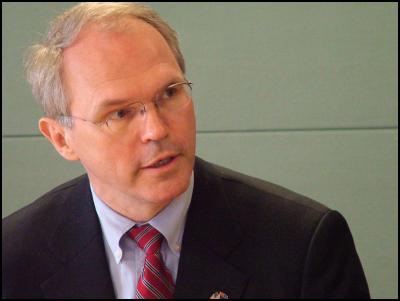
US Assistant Secretary of State Chris Hill told the U.S.-Korea Institute at Johns Hopkins University on Wednesday that the US is "not going to live with a nuclear North Korea. . . . We are not going to accept it." North Korea "can have a future, or it can have these weapons. It cannot have both."

Then again, in an interview with CNN: "We're just not going to accept that North Korea, with its starving population, is going to be able to join the nuclear club. . . . We're going to work very hard to make sure North Korea understands the cost of this [North Korean leader Kim Jong Il] is going to really rue the day that he made this decision."

Perhaps the US should take note of former UK Prime Minister Baroness Margaret Thatcher's reaction to the 1998 nuclear tests by India and Pakistan. She said, "huffing and puffing about test bans and non-proliferation" will not prevent major powers also becoming nuclear powers.


I have been wondering why France has not joined in the chorus of protest and condemnation that has greeted the North Korea nuclear test. A search on CNN and BBC has not turned up an official statement. Perhaps that has something to do with this:

"We can see that the tests occurred, and therefore the threat of sanctions did not work. We have to talk together and then talk to India and Pakistan in a more understanding way, even as we make clear that we disapprove of what they have done," French President Jacques Chirac opposing imposing economic sanctions on India and Pakistan following their nuclear bomb tests in May 1998.

Monday, October 09, 2006

The Nuclear Club Should Be Dissolved

Now that North Korea has apparently tested a nuclear weapon, the world will hopefully be forced to address the issue of how to reform the outdated and ineffective institutions and treaties that govern international relations. The Nuclear Non-Proliferation Treaty, just like many other relics of the post-WW2 and Cold War era, has proven unable to address the challenges of the 21st Century. They were designed to keep the peace in an age dominated by big military powers, when just the threat of war was sufficient to intimidate most into towing the line. Today, when 19 men with box-cutters can strike terror into a nation of 300 million and 10,000 Hizbullah guerillas can fight the largest and best equipped military in the Middle East to a standstill, such agreements seem obsolete.

A New World Order is called for. One that acknowledges the realities of today. There has been a devolution of power away from the armies of the nation-state. From the Russian failures in Afganistan and Chechnya to the US fiascos in Vietnam and Iraq, the limitations of military power are plain to see. Conversely, much of the destructive force that was formerly exclusive to governments is increasingly being developed by small groups. Remember the Aum Shinrikyo Sarin gas attack on the Tokyo subway and the anthrax-in-the-mail scares in the US? These chemical and biological attacks were not perpetrated by governments but by small bands of fanatics. Dirty bombs and suitcase-size nuclear devices are not far behind.

State nuclear weapons do not necessarily threaten the peace. In fact, nuclear weapons were largely responsible for the fact that the Cold War never heated up; they made the idea of war between the US and the USSR unthinkable. The real threat comes from a proliferation of nuclear weapon states and the consequent danger of WMD falling into the hands of terrorists. A nuclear arms race is a terrorist's dream come true. At the moment, it is exceedingly difficult and expensive to manufacture a nuclear weapon, even a crude one. Many terrorist groups thus look to nuclear weapon states to provide them with the necessary material and technology. The more nuclear states, the higher the chances of this happening.

A North Korean nuclear weapon may spark a nuclear arms race in the Far East (especially considering the new Japanese Prime Minister's call for a review of the country's pacifist constitution.) However for the Big 5 nuclear states (US, UK, France, Russia, China) to assume that their arsenals do not drive proliferation is ridiculous. India developed its nuclear weapon largely as a counter to China's and Pakistan developed one because of India. Pakistan sold weapons technology to Iran which faces an Israeli nuclear weapon provided by the US. There are fears that North Korea may sell its technology to terrorists or "rogue" regimes though there has been no evidence that it has done so. On the other hand, the US has not only dropped an atomic bomb on a non-nuclear country but has also provided countless undesirables with the weaponry to conduct proxy war. Saddam Hussein and Osama bin Laden spring to mind. So who is to say the DPRK poses a greater threat? The fact is as long as any one country has WMD, others will feel it in their security interests to get such weapons.

My suggested solution would be to ensure that all nations are equally protected by the existing WMD stockpiles. That means handing over all WMD to a commonly accepted central authority that would be mandated to fire in retaliation whenever one nation launched a nuclear attack on another. This authority would also be charged with nuclear research and the distribution of all the civillian benefits freely to all nations.