
Showing posts with label Nuclear Test. Show all posts
Showing posts with label Nuclear Test. Show all posts
Tuesday, May 26, 2009


Tuesday, October 10, 2006
Huffing and Puffing
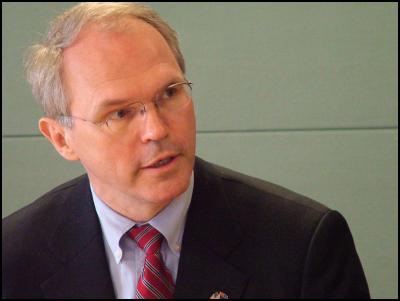 US Assistant Secretary of State Chris Hill told the U.S.-Korea Institute at Johns Hopkins University on Wednesday that the US is "not going to live with a nuclear North Korea. . . . We are not going to accept it." North Korea "can have a future, or it can have these weapons. It cannot have both."
Then again, in an interview with CNN: "We're just not going to accept that North Korea, with its starving population, is going to be able to join the nuclear club. . . . We're going to work very hard to make sure North Korea understands the cost of this [North Korean leader Kim Jong Il] is going to really rue the day that he made this decision."
Perhaps the US should take note of former UK Prime Minister Baroness Margaret Thatcher's reaction to the 1998 nuclear tests by India and Pakistan. She said, "huffing and puffing about test bans and non-proliferation" will not prevent major powers also becoming nuclear powers.
I have been wondering why France has not joined in the chorus of protest and condemnation that has greeted the North Korea nuclear test. A search on CNN and BBC has not turned up an official statement. Perhaps that has something to do with this:
"We can see that the tests occurred, and therefore the threat of sanctions did not work. We have to talk together and then talk to India and Pakistan in a more understanding way, even as we make clear that we disapprove of what they have done," French President Jacques Chirac opposing imposing economic sanctions on India and Pakistan following their nuclear bomb tests in May 1998.
Monday, October 09, 2006
The Nuclear Club Should Be Dissolved
Now that North Korea has apparently tested a nuclear weapon, the world will hopefully be forced to address the issue of how to reform the outdated and ineffective institutions and treaties that govern international relations. The Nuclear Non-Proliferation Treaty, just like many other relics of the post-WW2 and Cold War era, has proven unable to address the challenges of the 21st Century. They were designed to keep the peace in an age dominated by big military powers, when just the threat of war was sufficient to intimidate most into towing the line. Today, when 19 men with box-cutters can strike terror into a nation of 300 million and 10,000 Hizbullah guerillas can fight the largest and best equipped military in the Middle East to a standstill, such agreements seem obsolete.
A New World Order is called for. One that acknowledges the realities of today. There has been a devolution of power away from the armies of the nation-state. From the Russian failures in Afganistan and Chechnya to the US fiascos in Vietnam and Iraq, the limitations of military power are plain to see. Conversely, much of the destructive force that was formerly exclusive to governments is increasingly being developed by small groups. Remember the Aum Shinrikyo Sarin gas attack on the Tokyo subway and the anthrax-in-the-mail scares in the US? These chemical and biological attacks were not perpetrated by governments but by small bands of fanatics. Dirty bombs and suitcase-size nuclear devices are not far behind.
State nuclear weapons do not necessarily threaten the peace. In fact, nuclear weapons were largely responsible for the fact that the Cold War never heated up; they made the idea of war between the US and the USSR unthinkable. The real threat comes from a proliferation of nuclear weapon states and the consequent danger of WMD falling into the hands of terrorists. A nuclear arms race is a terrorist's dream come true. At the moment, it is exceedingly difficult and expensive to manufacture a nuclear weapon, even a crude one. Many terrorist groups thus look to nuclear weapon states to provide them with the necessary material and technology. The more nuclear states, the higher the chances of this happening.
A North Korean nuclear weapon may spark a nuclear arms race in the Far East (especially considering the new Japanese Prime Minister's call for a review of the country's pacifist constitution.) However for the Big 5 nuclear states (US, UK, France, Russia, China) to assume that their arsenals do not drive proliferation is ridiculous. India developed its nuclear weapon largely as a counter to China's and Pakistan developed one because of India. Pakistan sold weapons technology to Iran which faces an Israeli nuclear weapon provided by the US. There are fears that North Korea may sell its technology to terrorists or "rogue" regimes though there has been no evidence that it has done so. On the other hand, the US has not only dropped an atomic bomb on a non-nuclear country but has also provided countless undesirables with the weaponry to conduct proxy war. Saddam Hussein and Osama bin Laden spring to mind. So who is to say the DPRK poses a greater threat? The fact is as long as any one country has WMD, others will feel it in their security interests to get such weapons.
My suggested solution would be to ensure that all nations are equally protected by the existing WMD stockpiles. That means handing over all WMD to a commonly accepted central authority that would be mandated to fire in retaliation whenever one nation launched a nuclear attack on another. This authority would also be charged with nuclear research and the distribution of all the civillian benefits freely to all nations.
A New World Order is called for. One that acknowledges the realities of today. There has been a devolution of power away from the armies of the nation-state. From the Russian failures in Afganistan and Chechnya to the US fiascos in Vietnam and Iraq, the limitations of military power are plain to see. Conversely, much of the destructive force that was formerly exclusive to governments is increasingly being developed by small groups. Remember the Aum Shinrikyo Sarin gas attack on the Tokyo subway and the anthrax-in-the-mail scares in the US? These chemical and biological attacks were not perpetrated by governments but by small bands of fanatics. Dirty bombs and suitcase-size nuclear devices are not far behind.
State nuclear weapons do not necessarily threaten the peace. In fact, nuclear weapons were largely responsible for the fact that the Cold War never heated up; they made the idea of war between the US and the USSR unthinkable. The real threat comes from a proliferation of nuclear weapon states and the consequent danger of WMD falling into the hands of terrorists. A nuclear arms race is a terrorist's dream come true. At the moment, it is exceedingly difficult and expensive to manufacture a nuclear weapon, even a crude one. Many terrorist groups thus look to nuclear weapon states to provide them with the necessary material and technology. The more nuclear states, the higher the chances of this happening.
A North Korean nuclear weapon may spark a nuclear arms race in the Far East (especially considering the new Japanese Prime Minister's call for a review of the country's pacifist constitution.) However for the Big 5 nuclear states (US, UK, France, Russia, China) to assume that their arsenals do not drive proliferation is ridiculous. India developed its nuclear weapon largely as a counter to China's and Pakistan developed one because of India. Pakistan sold weapons technology to Iran which faces an Israeli nuclear weapon provided by the US. There are fears that North Korea may sell its technology to terrorists or "rogue" regimes though there has been no evidence that it has done so. On the other hand, the US has not only dropped an atomic bomb on a non-nuclear country but has also provided countless undesirables with the weaponry to conduct proxy war. Saddam Hussein and Osama bin Laden spring to mind. So who is to say the DPRK poses a greater threat? The fact is as long as any one country has WMD, others will feel it in their security interests to get such weapons.
My suggested solution would be to ensure that all nations are equally protected by the existing WMD stockpiles. That means handing over all WMD to a commonly accepted central authority that would be mandated to fire in retaliation whenever one nation launched a nuclear attack on another. This authority would also be charged with nuclear research and the distribution of all the civillian benefits freely to all nations.
Subscribe to:
Posts (Atom)